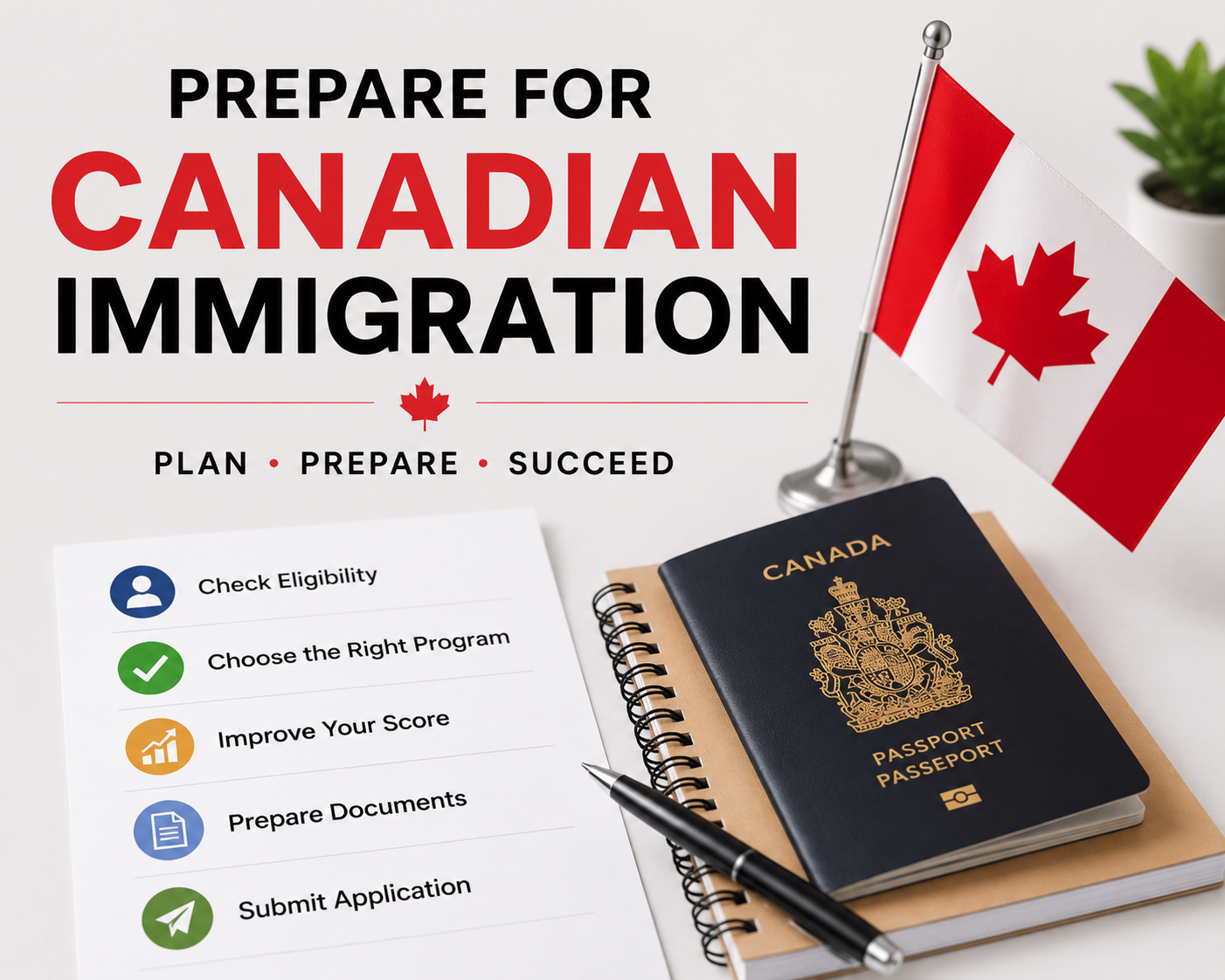


Most immigration mistakes happen before the application is even submitted.
People spend months researching Canadian immigration pathways, comparing programs, and calculating CRS scores — then submit an application with a wrong NOC code, an expired language score, or missing documentation that stalls everything.
Preparation is not just paperwork. It is doing the right things in the right order before you touch the application.
Here is what that actually looks like.
Before anything else, get clarity on which immigration pathway fits your profile.
Express Entry is not one program — it is three. The Federal Skilled Worker Program, the Federal Skilled Trades Program, and the Canadian Experience Class each have different eligibility criteria.
Provincial Nominee Programs have dozens of streams across thirteen provinces and territories — each with their own requirements.
The question is not "can I immigrate to Canada?" It is "which specific program am I eligible for right now — and which gives me the best realistic chance?"
Do not assume. Research each stream against your specific profile before deciding where to focus.
Your National Occupational Classification code determines your eligibility, your points, and which streams are available to you.
This is not about finding a code that sounds close to your job title. It is about finding the code whose lead statement and listed duties accurately reflect what you actually do every day.
Common mistakes:
Get this right before you build anything else. Everything else depends on it.
Your language score is one of the most controllable factors in your CRS score — and one of the most commonly underestimated.
What to know:
Take the test early enough to retake it if your scores are not where they need to be.
If you studied outside Canada, your foreign degree needs a formal Educational Credential Assessment before it counts in your Express Entry profile.
The most commonly used organization is World Education Services. The process takes several weeks — start it early.
What the ECA determines:
Skipping this step leaves education points on the table. Starting it late delays your entire application.
Your work experience is self-reported when you create an Express Entry profile — but it needs to be verified with documentation when you submit a full PR application.
Collect now, not later:
For foreign employers: Brief them on what the letter needs to contain. A well-structured letter from a foreign employer carries full weight when it meets IRCC's standards.
If you work in a regulated profession — medicine, nursing, engineering, law, teaching, accounting — your foreign credentials do not automatically transfer to Canada.
Each province regulates these professions independently. The assessment process, bridging program requirements, and licensing exams vary by province and profession.
The right move:
Contact the regulatory body for your profession in your target province before you submit your immigration application. Understand the timeline and requirements. Starting this process early means you can work in your field sooner after you arrive.
Federal immigration gives you the right to live anywhere in Canada. But your choice of province affects your options significantly.
Different provinces have different PNP streams, different occupation priorities, different cost of living, and different job markets for your field.
Questions worth answering before you choose:
Choosing a province strategically — rather than defaulting to Toronto or Vancouver — can open pathways and reduce costs significantly.
Once your language score is valid, your ECA is complete, and your documentation is organized — build your Express Entry profile.
Common profile mistakes:
Your profile is a legal document. Every claim in it needs to be accurate and supportable. Inaccuracies that surface during processing can result in refusal — or worse, a misrepresentation finding.
Running a federal Express Entry profile and exploring provincial nominee programs simultaneously is not just allowed — it is smart.
A provincial nomination adds 600 CRS points — a guaranteed federal invitation. For candidates whose base CRS score is below the typical draw threshold, a provincial stream may be the more realistic path.
Check which provinces have active streams matching your occupation and profile. Apply where you qualify. The two tracks run in parallel and do not conflict.
Immigration takes time and costs money — in ways applicants consistently underestimate.
Budget for:
Have enough in savings to cover these costs without financial stress. Running out of money mid-process forces bad decisions.
The applicants who move through Canadian immigration smoothly are almost never the ones who got lucky. They are the ones who did the groundwork before they needed it.
Correct NOC code. Strong language score. Valid credential assessment. Complete employment documentation. A provincial strategy running alongside federal Express Entry.
None of these steps are complicated. What they require is doing them in the right order, early enough, before the application demands them.
Start before you think you need to. That is the whole preparation strategy in one sentence.
1. How far in advance should I start preparing for Canadian immigration?
Ideally six to twelve months before you plan to submit an application. Some steps — like credential recognition for regulated professions — can take longer and should start even earlier.
2. Do I need an immigration lawyer or consultant to apply?
Not necessarily. Many applicants successfully navigate Express Entry independently. However, complex situations — regulated professions, prior refusals, criminal history, unusual work arrangements — benefit significantly from professional guidance.
3. Can I start the Express Entry process before my language test results are back?
You need a valid language score to create an Express Entry profile. Take the test first — then build your profile once you have official results in hand.
4. What if my documentation for past employment is incomplete?
Document what you have as thoroughly as possible and explain gaps honestly. Missing documentation for older or less relevant roles is less serious than gaps in your most recent or most claimed experience. Never fabricate or exaggerate documentation.
5. How often should I update my Express Entry profile after creating it?
Review and update your profile any time your circumstances change — new job, new language score, new educational credential. Also check it periodically to ensure nothing has expired, particularly your language score, which is only valid for two years.
Having an ‘Identity Verified’ badge or being ‘Identity Verified’ simply indicates that an individual has submitted information to complete our identity verification process or we have conducted internal verification using various authorized websites. While this process includes safeguards, it does not guarantee that the person is who they claim to be.
If you encounter any issues with this profile, please report them here. While all consultants who are verified have RCIC ID, we may not have the latest data in terms of their renewal/cancellation/discontinuation of their RCIC ID.
╳The “Verified Consultants” profiles on Immiperts.com are independently compiled using publicly available information from multiple sources, including the official CICC Public Register, consultants’ own websites, other public directories, and social media.
Immiperts.com is a completely independent platform and is not affiliated with, endorsed by, or connected to the College of Immigration and Citizenship Consultants (CICC), IRCC, or any immigration consultant.
All information is collected manually and is for educational and informational purposes only. Consultants may claim, update, or request removal of their profile by contacting us at hello@immiperts.com.
Users are strongly advised to always verify the latest authorization status directly on the official CICC Public Register at college-ic.ca.