
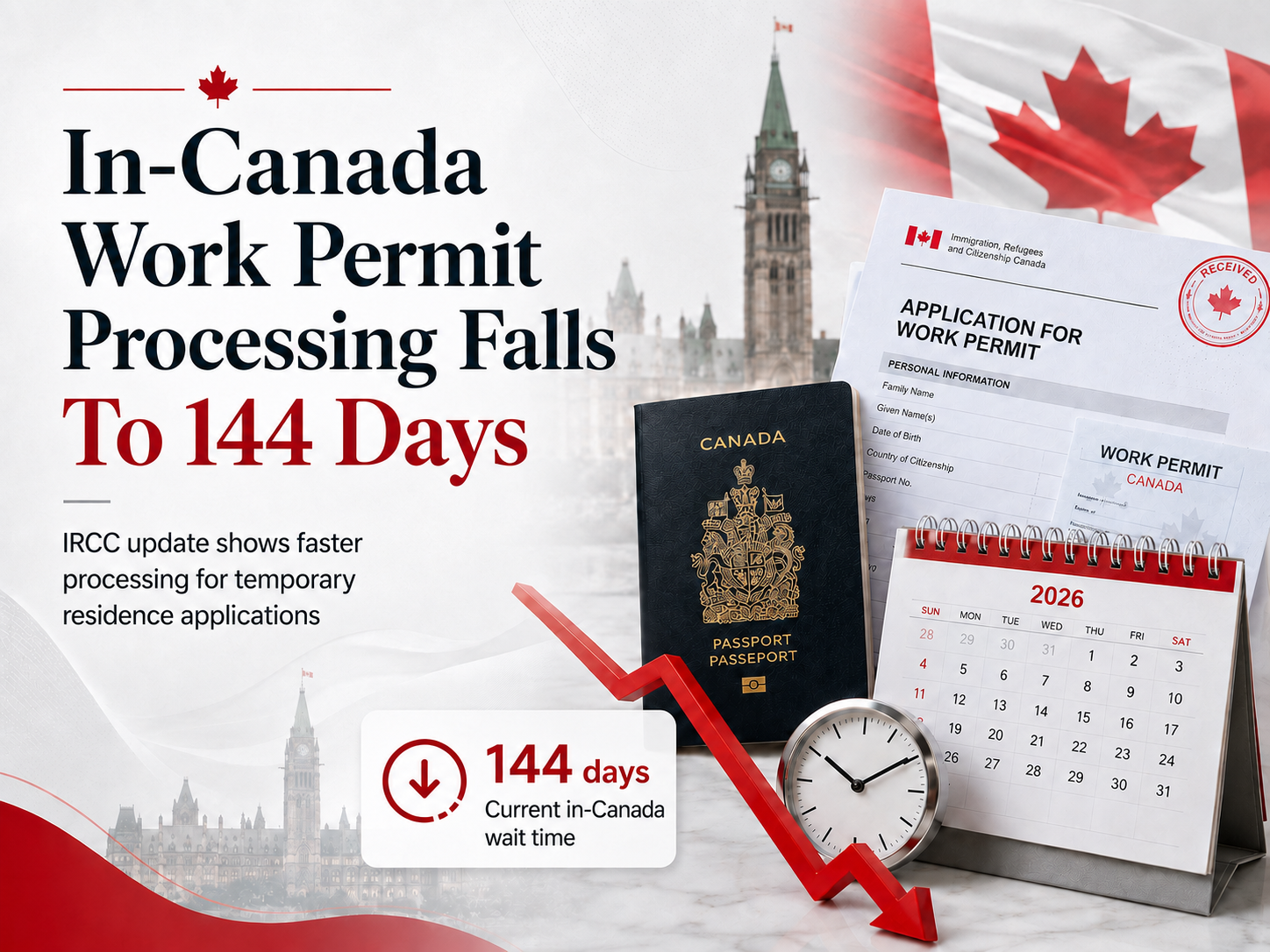


Canada has reported a sharp improvement in processing times for some temporary residence applications, with in-Canada work permit wait times falling to their lowest level so far this year.
Immigration, Refugees and Citizenship Canada released its latest processing update on June 24. The figures show faster timelines for work permits, study permits, visitor visas and super visas in several categories compared with June 17.
The biggest change came in work permit processing.
For people applying from inside Canada, the wait time dropped from 171 days to 144 days. This marks the lowest in-Canada work permit processing time reported in 2026 so far.
Applicants applying from Nigeria also saw a major improvement. Their wait time fell from 16 weeks to nine weeks, a drop of seven weeks.
Work permit timelines stayed the same for several other countries. Applications from India remained at nine weeks, Pakistan at five weeks, the United States at four weeks, and the Philippines at eight weeks.
IRCC’s service standard is 120 days for initial and extension work permit applications submitted inside Canada. For applications submitted from outside Canada, the service standard is 60 days.
Study permit processing also improved for applicants from India and Nigeria.
India’s wait time dropped from five weeks to four weeks. Nigeria’s wait time fell from six weeks to five weeks.
Other study permit timelines did not change. Applications from inside Canada remained at six weeks. Pakistan stayed at six weeks, the United States at five weeks, and the Philippines at four weeks.
For study permits, IRCC’s service standard is 120 days for applications submitted from inside Canada and 60 days for applications submitted from outside Canada.
Visitor visa processing times changed only slightly over the week.
Applications from inside Canada improved from 44 days to 42 days. India also saw a small drop, from 24 days to 22 days.
Pakistan remained unchanged at 43 days. The United States stayed at 31 days, and the Philippines remained at 17 days.
Nigeria saw a slight increase, rising from 53 days to 54 days.
IRCC lists no service standard for visitor visa applications submitted from inside Canada. For applications submitted from outside Canada, the service standard is 14 days.
Super visa processing showed one of the largest improvements for Indian applicants. The wait time dropped from 110 days to 66 days, a decrease of 44 days.
Nigeria also saw a small improvement, moving from 35 days to 34 days.
Pakistan recorded the largest increase, rising from 84 days to 95 days. The United States also increased from 101 days to 104 days, while the Philippines rose from 41 days to 42 days.
Super visa applications can only be submitted from outside Canada. IRCC’s service standard for these applications is 112 days.
IRCC publishes processing times to help applicants understand how long an application may take. These timelines are estimates, not guarantees.
The department uses two types of estimates. Historical estimates are based on how long it took IRCC to finalize 80 per cent of past applications. Forward-looking estimates are based on current application numbers and available processing capacity.
Service standards are different. They are internal targets used to measure whether IRCC is meeting expected timelines under normal conditions. In most cases, the goal is to complete about 80 per cent of applications within the stated period.
IRCC updates temporary residence processing times weekly. Permanent residence and citizenship processing times are usually updated monthly. Temporary residence service standards have not been updated since 2018–2019.









Having an ‘Identity Verified’ badge or being ‘Identity Verified’ simply indicates that an individual has submitted information to complete our identity verification process or we have conducted internal verification using various authorized websites. While this process includes safeguards, it does not guarantee that the person is who they claim to be.
If you encounter any issues with this profile, please report them here. While all consultants who are verified have RCIC ID, we may not have the latest data in terms of their renewal/cancellation/discontinuation of their RCIC ID.
╳The “Verified Consultants” profiles on Immiperts.com are independently compiled using publicly available information from multiple sources, including the official CICC Public Register, consultants’ own websites, other public directories, and social media.
Immiperts.com is a completely independent platform and is not affiliated with, endorsed by, or connected to the College of Immigration and Citizenship Consultants (CICC), IRCC, or any immigration consultant.
All information is collected manually and is for educational and informational purposes only. Consultants may claim, update, or request removal of their profile by contacting us at hello@immiperts.com.
Users are strongly advised to always verify the latest authorization status directly on the official CICC Public Register at college-ic.ca.