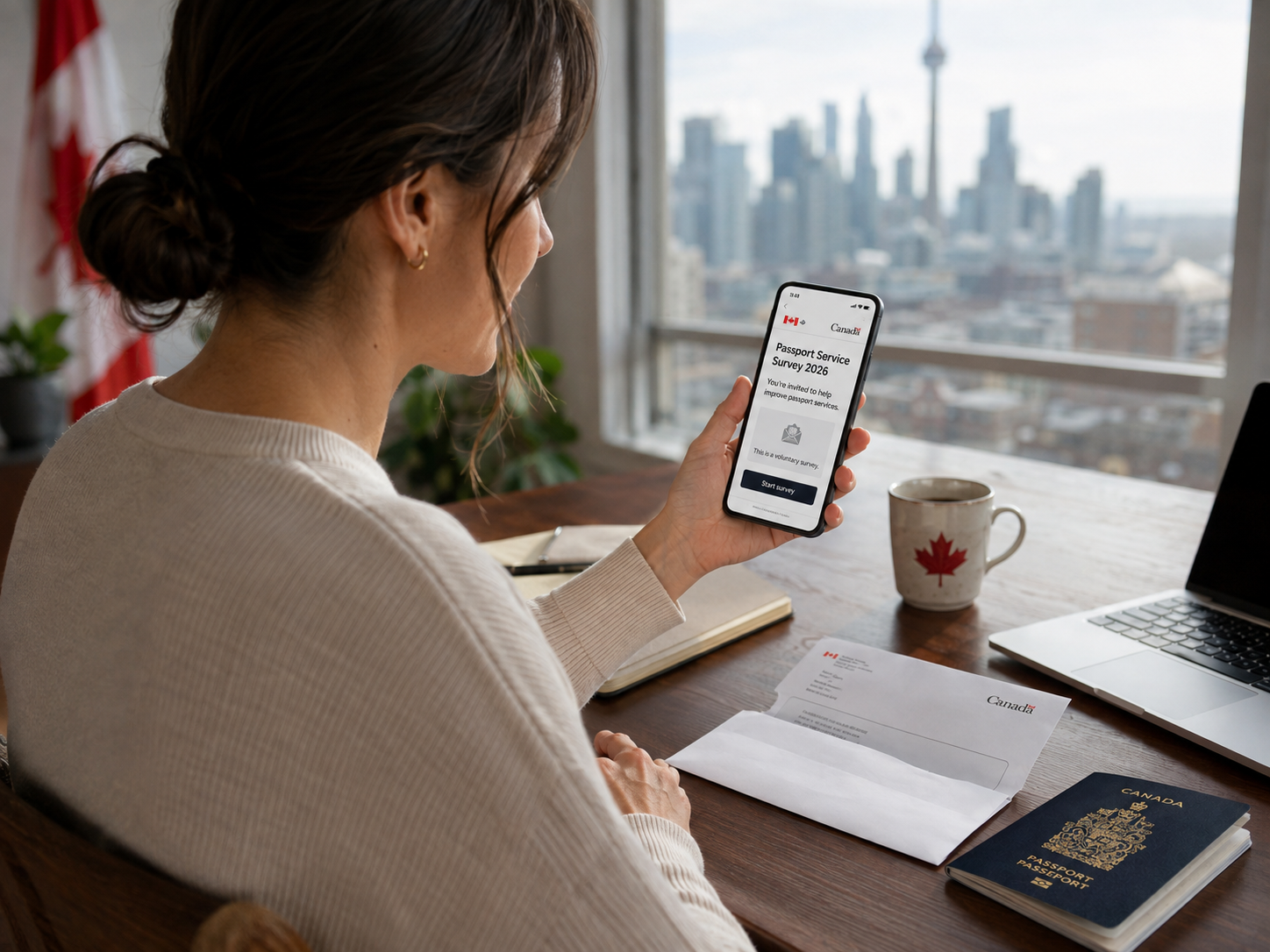


An unexpected passport email can feel risky. Scammers often use government logos and urgent wording, so Canadians may worry that a survey invitation is trying to collect private information. The Government of Canada has confirmed, however, that a genuine passport client experience survey is taking place in 2026.
The government is contacting a randomly selected group of people who received a Canadian passport between January 1 and June 30, 2026. Invitations may arrive from August to October 2026. The goal is to understand whether the Passport Program met clients’ expectations and where the service could improve.
Advanis, an independent research firm, is conducting the survey. It takes about 15 to 20 minutes, is available in English and French, and is voluntary. Participating or declining will not affect any past, current, or future passport application.
You may be contacted if:
Some people will receive an email. Others may find an online survey invitation included with their new passport. Not everyone in the eligible group will be contacted.
The survey focuses on the passport service itself. Questions may cover how you applied, whether the instructions were clear, whether the process met expectations, and how satisfied you were.
Application numbers show how many passports were processed, but they do not explain where clients felt confused or frustrated. Feedback can identify unclear instructions, communication gaps, or difficulties with a service channel.
The government says the results will help identify trends and opportunities to improve the client experience. IRCC also confirms that it routinely runs surveys to understand whether its services meet users’ needs.
A genuine invitation should have these details:
The Advanis address may seem unusual because it does not end in “gc.ca.” The official Government of Canada notice confirms that Advanis is running the survey and lists this sender and link prefix.
The official survey will not ask for:
IRCC says its client surveys do not request money, financial details, passwords, passport numbers, or similar sensitive information. An email asking for these details is not the official survey.
Do not click immediately, even when an email includes a Canadian flag or government-style design.
The government advises people not to click links in suspicious survey messages. Scammers can copy public details from a real campaign, so check both the sender and the information requested.
No. The survey is separate from passport decision-making. You can decline or ignore the invitation without affecting a passport already issued, an application in progress, or a future application.
The government also says responses will be kept confidential. The survey studies overall experiences and service trends; it does not reconsider whether someone should receive a passport.
That decision is yours. Participating lets you explain what worked and what could have been clearer during your passport application.
You may wish to comment on:
Useful feedback may support future improvements, but there is no penalty for declining.
The 2026 passport survey is genuine, but trust a message only after confirming its sender, link, and questions. A real survey asks about your experience. It does not demand money, your passport number, passwords, or banking details.
Yes. The Government of Canada lists it as the sender for the 2026 passport survey. Check every character because a fraudulent address may look almost identical.
No. Only randomly selected people whose passports were issued from January 1 to June 30, 2026, may be invited. Receiving no email does not mean anything is wrong.
No. Participation is voluntary and will not affect any past, current, or future passport application. You do not have to explain why you declined.
No. The official survey will not ask for your passport number or financial information. Leave the survey if it requests those details.
It takes about 15 to 20 minutes and is offered in English and French. Invitations are being sent from August through October 2026.
Having an ‘Identity Verified’ badge or being ‘Identity Verified’ simply indicates that an individual has submitted information to complete our identity verification process or we have conducted internal verification using various authorized websites. While this process includes safeguards, it does not guarantee that the person is who they claim to be.
If you encounter any issues with this profile, please report them here. While all consultants who are verified have RCIC ID, we may not have the latest data in terms of their renewal/cancellation/discontinuation of their RCIC ID.
╳The “Verified Consultants” profiles on Immiperts.com are independently compiled using publicly available information from multiple sources, including the official CICC Public Register, consultants’ own websites, other public directories, and social media.
Immiperts.com is a completely independent platform and is not affiliated with, endorsed by, or connected to the College of Immigration and Citizenship Consultants (CICC), IRCC, or any immigration consultant.
All information is collected manually and is for educational and informational purposes only. Consultants may claim, update, or request removal of their profile by contacting us at hello@immiperts.com.
Users are strongly advised to always verify the latest authorization status directly on the official CICC Public Register at college-ic.ca.