



A recent change in Canada’s citizenship law may help nearly 300,000 Connecticut residents with Canadian ancestry apply for dual citizenship and a Canadian passport.
Nearly 300,000 Connecticut residents may now qualify as U.S.-Canadian dual citizens after Canada changed its citizenship by descent rules.
The update to Canada’s Citizenship Act took effect on December 15, 2025. It removed the generational limit for people born before that date who can show a direct family line to a Canadian ancestor.
That means Connecticut residents with Canadian ancestry may be able to apply for proof of Canadian citizenship. Once approved, they can use that certificate to apply for a Canadian passport.
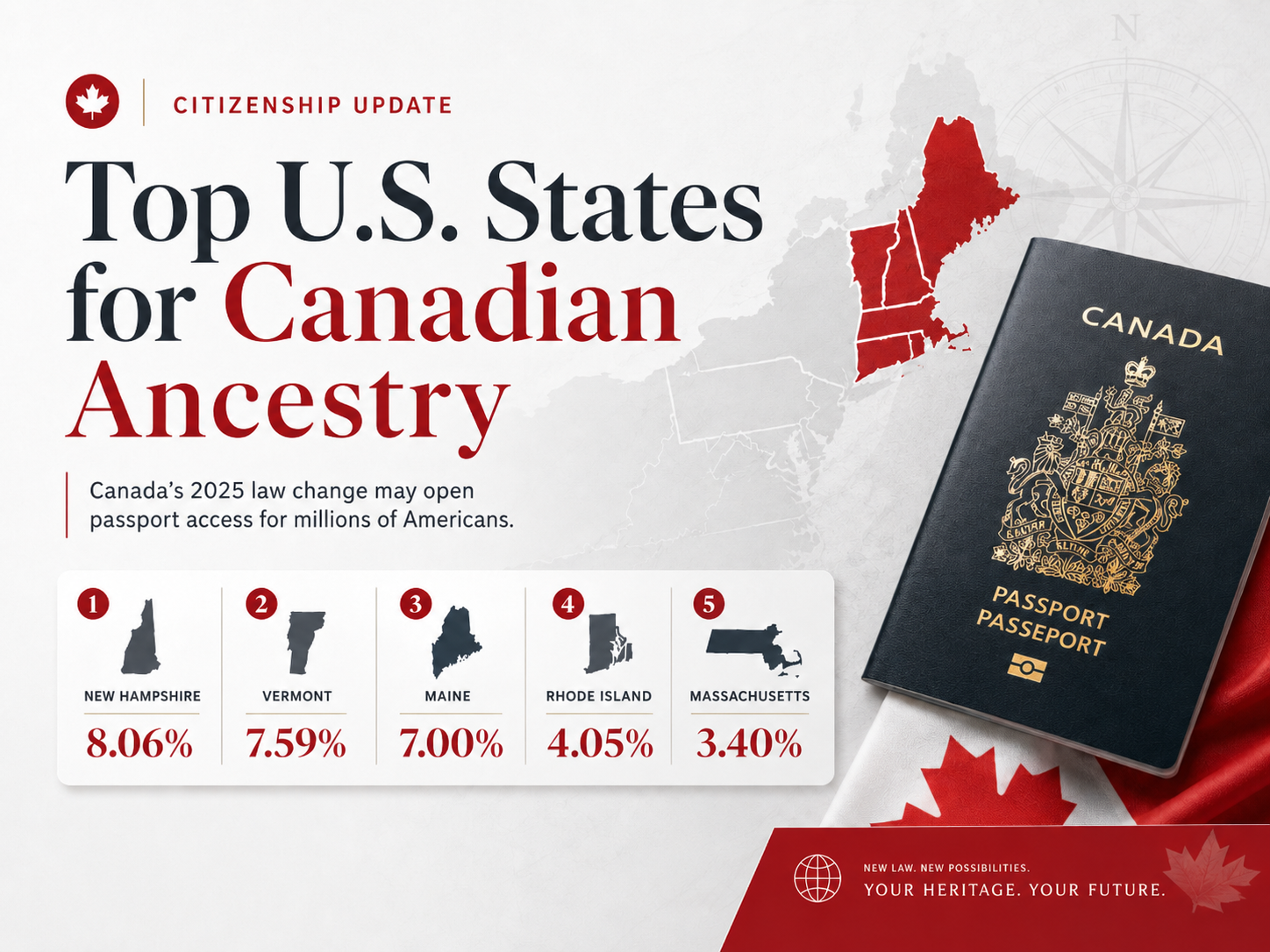
About nine per cent of people living in Connecticut are estimated to have Canadian ancestry. That estimate is based on research by Patrick White and data from the U.S. Census Bureau.
Much of this history goes back to “La Grande Saignée,” or “The Great Hemorrhage.” This was the migration of nearly 900,000 French Canadians from Quebec to New England between 1840 and 1930 in search of work.
By the end of that period, Connecticut was home to more than 67,000 French Canadians. Over time, their descendants grew into a much larger population with at least one Canadian ancestor.
Americans who were born in the United States and have at least one Canadian ancestor may already qualify as dual citizens. However, they must first get official confirmation from Immigration, Refugees and Citizenship Canada.
This confirmation comes through a proof of Canadian citizenship certificate.
Most Americans must apply on paper. They need to include official documents that show their Canadian ancestry. These may include birth certificates, marriage licences, baptismal records, and other family documents.
More than 56,000 people are currently waiting for processing. At the time of writing, the processing time for a Canadian citizenship certificate is 10 months. That means someone applying now could have their citizenship officially confirmed by March 2027, if the application is successful and no delays occur.
For many applicants, finding the right documents may be the hardest part.
Some Connecticut residents may need records from Quebec that are more than 100 years old, especially if they are claiming citizenship through a great-grandparent or a more distant French-Canadian ancestor.
Quebec’s national archives, the Bibliothèque et Archives nationales du Québec, has reported a 3,000 per cent increase in requests after Canada’s citizenship law changed. Most of those requests are from Americans.
Because the archives give priority to Quebec residents, some Americans may choose to hire licensed representatives based in Quebec to help collect the needed records.
After receiving proof of Canadian citizenship, a dual citizen can apply for a Canadian passport. The Canadian passport currently ranks above the U.S. passport on the Henley Passport Index.
It also gives access to youth mobility programs in 36 countries, including Italy, Japan, and Switzerland, where eligible people may live and work for up to two years.
Canadian passport processing usually takes 10 to 20 days. The federal government offers an automatic full refund if an application is not processed within 30 days.
Dual citizens can live, work, and enter both Canada and the United States without restriction. They may also access Canadian health care and social services if they establish residency in Canada.Canadian citizenship does not create extra tax duties for Americans unless they become residents of Canada or build financial ties there, such as owning property, businesses, or other assets.








Having an ‘Identity Verified’ badge or being ‘Identity Verified’ simply indicates that an individual has submitted information to complete our identity verification process or we have conducted internal verification using various authorized websites. While this process includes safeguards, it does not guarantee that the person is who they claim to be.
If you encounter any issues with this profile, please report them here. While all consultants who are verified have RCIC ID, we may not have the latest data in terms of their renewal/cancellation/discontinuation of their RCIC ID.
╳The “Verified Consultants” profiles on Immiperts.com are independently compiled using publicly available information from multiple sources, including the official CICC Public Register, consultants’ own websites, other public directories, and social media.
Immiperts.com is a completely independent platform and is not affiliated with, endorsed by, or connected to the College of Immigration and Citizenship Consultants (CICC), IRCC, or any immigration consultant.
All information is collected manually and is for educational and informational purposes only. Consultants may claim, update, or request removal of their profile by contacting us at hello@immiperts.com.
Users are strongly advised to always verify the latest authorization status directly on the official CICC Public Register at college-ic.ca.