
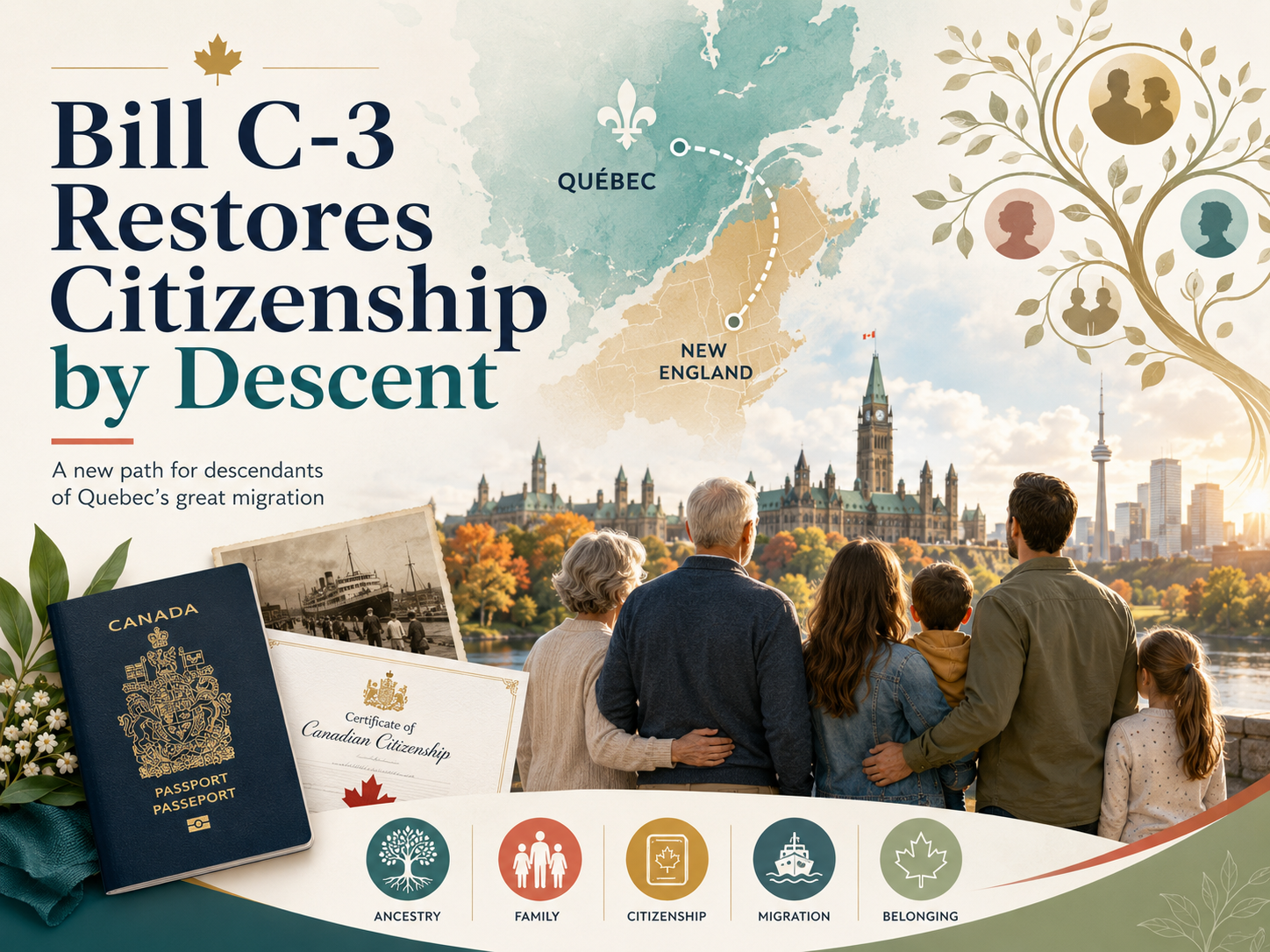


Bill C-3 may allow many Americans with French-Canadian ancestry to claim Canadian citizenship by descent.
A major change to Canada’s citizenship law is giving many Americans with French-Canadian ancestry a new connection to Canada.
Bill C-3, which came into force on December 15, 2025, removed the first-generation limit on Canadian citizenship by descent for many people born before that date. The change may affect descendants of Quebec’s historic migration to the United States, including families whose ancestors left Canada generations ago.
Between 1840 and 1930, about 900,000 people left Quebec for the United States. The movement became known in French as la grande saignée, often translated as the great bleeding or great hemorrhage.
Many families left because rural Quebec communities faced overcrowding and limited economic opportunities. At the same time, industrial jobs were growing in New England.
Railway links made travel easier and cheaper, allowing many Quebec families to move south. Thousands settled in mill towns, where textile factories employed entire families.
Many French Canadians eventually returned to Quebec, but others stayed in the United States and built close communities.
These communities became known as les Petits Canada, or the Little Canadas of America. They helped preserve French-Canadian language, faith, food, and cultural traditions across New England.
Cities and towns such as Lowell and Fall River in Massachusetts, Manchester and Nashua in New Hampshire, Burlington in Vermont, Lewiston in Maine, and Woonsocket in Rhode Island still carry signs of this history.
Some communities continue to celebrate that heritage through festivals such as La Kermesse in Biddeford, Maine, and the Leominster French Canadian Festival in Massachusetts.
Before Bill C-3, citizenship by descent was limited in many cases to the first generation born outside Canada.
The new law removed that limit for many people born before December 15, 2025. This means some Americans who can prove a continuous family connection to a Canadian ancestor may now be recognized as Canadian citizens by descent.
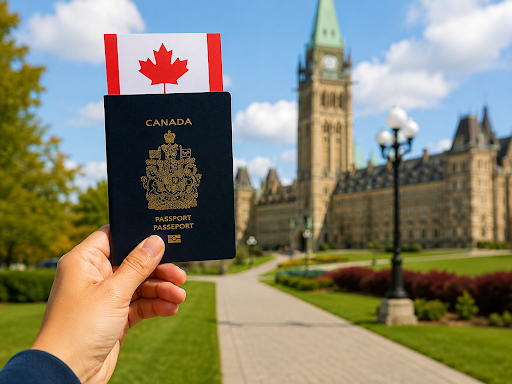
For descendants of Quebec’s great migration, this could be significant. A person with a French-Canadian ancestor may be able to apply for proof of Canadian citizenship and later apply for a Canadian passport.
The article notes that there is no residency requirement, citizenship test, or oath ceremony for this proof-of-citizenship process.
People with family history in New England may have a higher chance of Canadian ancestry.
Common Quebec surnames include Tremblay, Gagnon, Côté, Bouchard, Lavoie, Bélanger, and Fortin. However, some names were changed or translated after families moved to the United States. Names such as White, King, Wood, Rivers, or Carpenter may sometimes reflect older French-Canadian names.
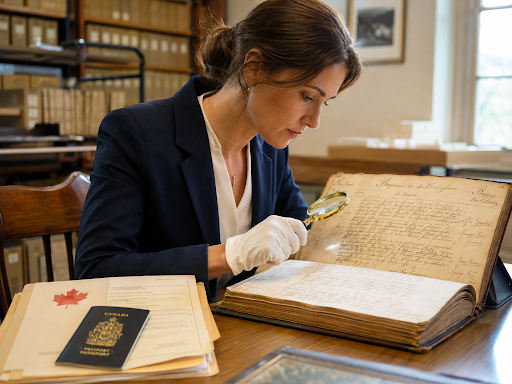
Applicants usually need documents such as birth certificates, marriage certificates, and baptismal records to prove each generation in the family line.
The article says more than 2,500 people applied for proof of Canadian citizenship in January 2026 alone.
Current processing is about 12 months. Once approved, applicants can apply for a Canadian passport.Canadian citizenship gives the right to live and work in Canada indefinitely. It also does not automatically create Canadian income tax obligations, because Canada taxes personal income mainly based on residency.











Having an ‘Identity Verified’ badge or being ‘Identity Verified’ simply indicates that an individual has submitted information to complete our identity verification process or we have conducted internal verification using various authorized websites. While this process includes safeguards, it does not guarantee that the person is who they claim to be.
If you encounter any issues with this profile, please report them here. While all consultants who are verified have RCIC ID, we may not have the latest data in terms of their renewal/cancellation/discontinuation of their RCIC ID.
╳The “Verified Consultants” profiles on Immiperts.com are independently compiled using publicly available information from multiple sources, including the official CICC Public Register, consultants’ own websites, other public directories, and social media.
Immiperts.com is a completely independent platform and is not affiliated with, endorsed by, or connected to the College of Immigration and Citizenship Consultants (CICC), IRCC, or any immigration consultant.
All information is collected manually and is for educational and informational purposes only. Consultants may claim, update, or request removal of their profile by contacting us at hello@immiperts.com.
Users are strongly advised to always verify the latest authorization status directly on the official CICC Public Register at college-ic.ca.