
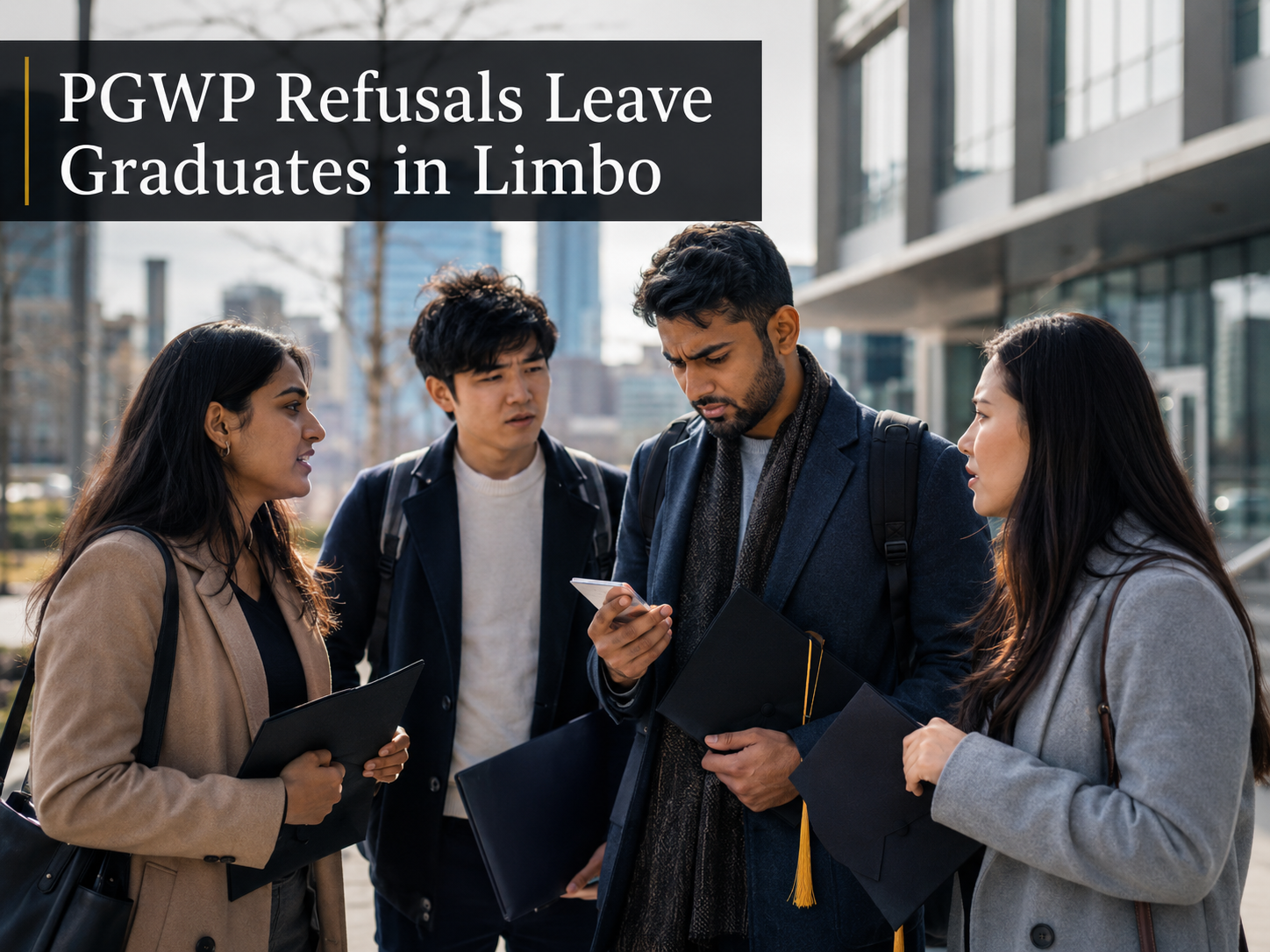


Hundreds of international graduates are seeking answers after their Canadian work permit applications were refused.
Hundreds of international graduates in Alberta say they have been left unable to work after Immigration, Refugees and Citizenship Canada refused their post-graduation work permit applications.
Many completed continuing-education programs connected to Portage College and delivered through partner locations, including the Canadian Institute of Osteopathic Therapy in Calgary and Campbell College in Edmonton. Reported programs include Business Management, Administrative Professional and Teacher Assistant diplomas.
Up to 480 Calgary graduates gathered on July 17 to protest the decisions. Similar concerns have been raised in Edmonton. Sikander Singh, who completed an Administrative Professional diploma, said students began their programs believing they could qualify for a permit if they met the stated conditions.
“We did everything on time…then we got our refusal letters in the mail,” Singh said.
The refusals arrived in late June and early July. Some graduates had already started working while their applications were being processed. Once notified of a refusal, they generally must stop working, leaving some without income and worried about losing their immigration status.
IRCC’s eligibility page says graduates are not eligible for a post-graduation work permit if they completed a non-credit program, except for qualifying flight-school training. The page shows a June 24, 2026, update.
IRCC says the department did not introduce a new rule. It told the media that the update clarified existing requirements for non-credit programs. Graduates argue the wording became clear only after they had enrolled, paid international tuition and, in many cases, submitted their applications.
A separate rule affects programs delivered by private colleges for public institutions. Students who began a same-province partnership program on or before May 15, 2024, may qualify if they meet every other requirement. However, that exception does not automatically overcome the non-credit restriction.
Some students say they started before the cutoff. Their cases may depend on the exact program, delivery site, credential, start date and documents submitted.
Portage College acknowledged on July 14 that some graduates of certain non-credit programs had received refusals. The college said IRCC alone decides immigration applications and that institutional letters cannot guarantee approval.
After receiving legal advice, Portage stopped issuing support letters on July 15. It advised graduates to keep their study permits, acceptance letters, transcripts, completion records, applications and refusal documents, and to consult an authorized immigration lawyer or regulated consultant.
Students have also questioned reports that about 50 graduates from apparently similar programs received permits. That figure has not been independently confirmed. Different outcomes could reflect differences between files, but graduates want IRCC to compare approved and refused applications.
The article’s publisher has urged Immigration Minister Lena Metlege Diab and IRCC to pause related refusals, create a centralized review team and consider temporary status protection while cases are examined. Diab currently serves as Canada’s immigration minister.
No court or government review has concluded that the refusals were unlawful. The central issue remains whether affected programs were correctly classified and whether students received clear, timely eligibility information before enrolling in Canada.










Having an ‘Identity Verified’ badge or being ‘Identity Verified’ simply indicates that an individual has submitted information to complete our identity verification process or we have conducted internal verification using various authorized websites. While this process includes safeguards, it does not guarantee that the person is who they claim to be.
If you encounter any issues with this profile, please report them here. While all consultants who are verified have RCIC ID, we may not have the latest data in terms of their renewal/cancellation/discontinuation of their RCIC ID.
╳The “Verified Consultants” profiles on Immiperts.com are independently compiled using publicly available information from multiple sources, including the official CICC Public Register, consultants’ own websites, other public directories, and social media.
Immiperts.com is a completely independent platform and is not affiliated with, endorsed by, or connected to the College of Immigration and Citizenship Consultants (CICC), IRCC, or any immigration consultant.
All information is collected manually and is for educational and informational purposes only. Consultants may claim, update, or request removal of their profile by contacting us at hello@immiperts.com.
Users are strongly advised to always verify the latest authorization status directly on the official CICC Public Register at college-ic.ca.