
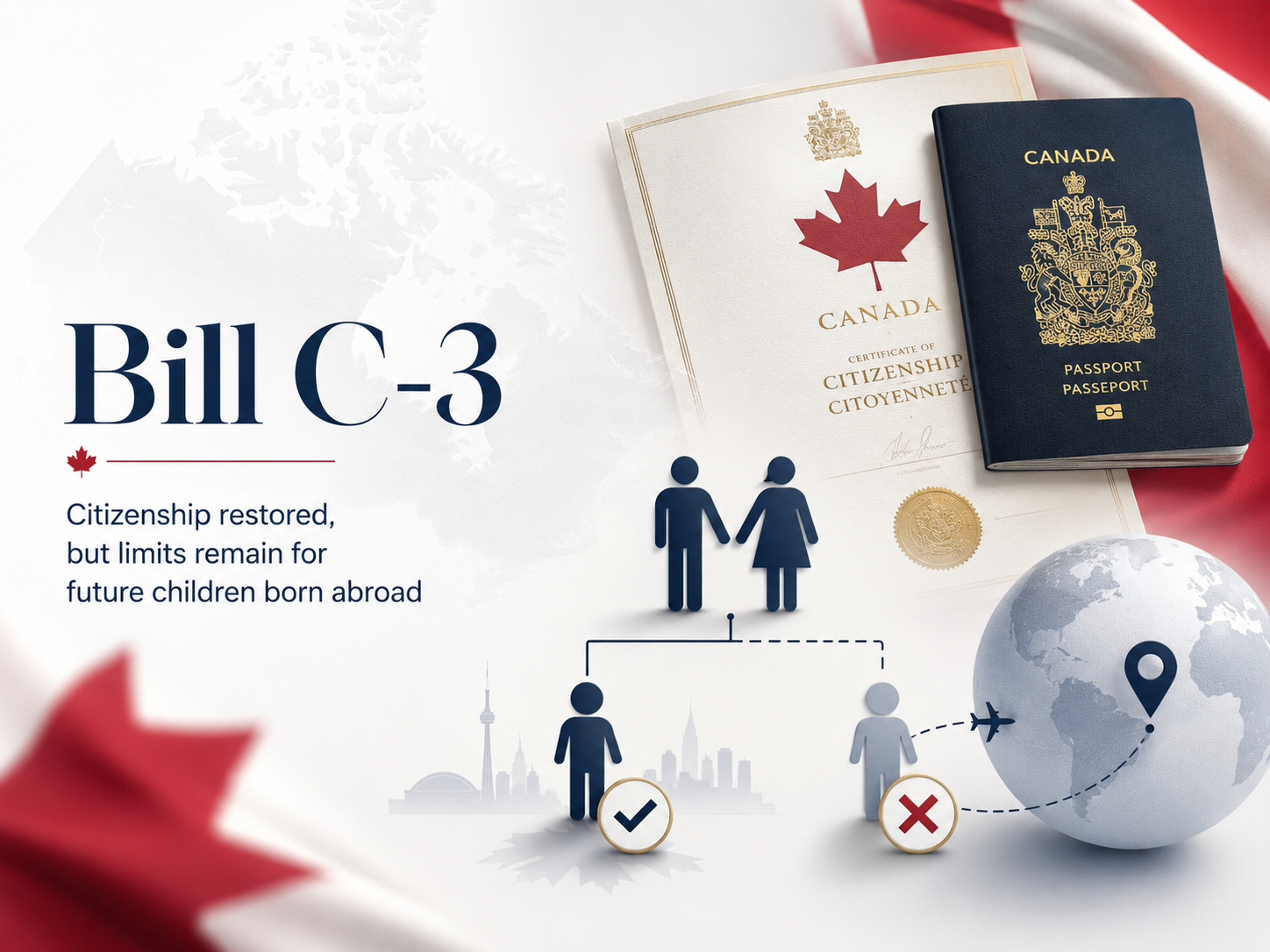


Bill C-3 restores citizenship for many families, but children born abroad after Dec. 15, 2025, face a new rule.
Bill C-3 has restored Canadian citizenship to people born before Dec. 15, 2025, who can show an unbroken family line to a Canadian ancestor. But the same law also creates a major limit for the next generation.
Under the new rule, children born abroad after Dec. 15, 2025, will not automatically receive Canadian citizenship from a Canadian parent who was also born outside Canada. The parent must first prove they spent at least 1,095 days, or about three years, physically present in Canada before the child’s birth or adoption.
The change can create different outcomes within the same family.
Consider Marie, a 38-year-old paediatric nurse in Boston. Her grandmother moved from Quebec to Massachusetts in the 1950s. Because Marie was born before Dec. 15, 2025, and can trace her family line back to a Canadian ancestor, Bill C-3 makes her eligible for Canadian citizenship.
Marie does not need to pass a language test or meet a special residency rule. She must apply for proof of Canadian citizenship and receive a certificate confirming her status.
Her son, Luc, was born in 2023. Since he was born before Dec. 15, 2025, to a parent recognized as Canadian, he is also automatically Canadian.
Her daughter, Camille, born in 2027, would face a different result. Because Camille was born after Dec. 15, 2025, and Marie has never lived in Canada, Camille would not automatically become Canadian.
The key issue is the substantial connection test.
For children born or adopted abroad after Dec. 15, 2025, a Canadian parent born abroad must show at least 1,095 cumulative days in Canada before the child’s birth or adoption.
Those days do not need to be consecutive. They can come from different periods of the parent’s life. But if the parent has never spent enough time in Canada, citizenship will not pass automatically.
The rule does not affect children born before Dec. 15, 2025.
The rule may also affect future generations.
Luc may be Canadian under Bill C-3, but if he grows up outside Canada and never spends three years in the country, his future children may not inherit citizenship.
Camille, meanwhile, would not have Canadian citizenship to pass on at all.
This means citizenship by descent could stop unless someone in the family line spends enough time in Canada.
Canada grants citizenship to most children born on Canadian soil. The main exception applies to children of accredited foreign diplomats.
For families like Marie’s, this can matter. If Camille were born in Canada instead of Boston, she would be Canadian by birth. The three-year physical presence test would not apply.
A newly recognized Canadian citizen also has the legal right to enter and stay in Canada. For some families planning children, giving birth in Canada may protect the child’s citizenship from day one.
Having a child in Canada does not make an American parent lose U.S. citizenship.
A child born in Canada to an American parent may also receive U.S. citizenship by descent, as long as the parent meets U.S. physical presence rules. Many adults raised in the United States may already meet that requirement.
This means some children could be Canadian and American from birth.
The birth-in-Canada option does not apply the same way to international adoption.
A child adopted abroad after Dec. 15, 2025, is still subject to the substantial connection test. Families planning international adoption should seek advice about how the rule applies to them.
Immigration, Refugees and Citizenship Canada has not yet released full instructions on how families must prove the 1,095 days.
In Senate testimony on Nov. 17, 2025, IRCC confirmed that the days are cumulative and do not need to fall within one set period. However, questions remain about what proof will be accepted and whether shorter visits, including childhood trips, will count.
Families affected by Bill C-3 should keep detailed records of time spent in Canada and seek legal guidance when planning for future children.











Having an ‘Identity Verified’ badge or being ‘Identity Verified’ simply indicates that an individual has submitted information to complete our identity verification process or we have conducted internal verification using various authorized websites. While this process includes safeguards, it does not guarantee that the person is who they claim to be.
If you encounter any issues with this profile, please report them here. While all consultants who are verified have RCIC ID, we may not have the latest data in terms of their renewal/cancellation/discontinuation of their RCIC ID.
╳The “Verified Consultants” profiles on Immiperts.com are independently compiled using publicly available information from multiple sources, including the official CICC Public Register, consultants’ own websites, other public directories, and social media.
Immiperts.com is a completely independent platform and is not affiliated with, endorsed by, or connected to the College of Immigration and Citizenship Consultants (CICC), IRCC, or any immigration consultant.
All information is collected manually and is for educational and informational purposes only. Consultants may claim, update, or request removal of their profile by contacting us at hello@immiperts.com.
Users are strongly advised to always verify the latest authorization status directly on the official CICC Public Register at college-ic.ca.