



Canada’s primary refugee claim backlog declined significantly in 2026, while pending appeals continued to increase.
Canada’s refugee claim backlog fell sharply during the first half of 2026 as the Immigration and Refugee Board completed far more cases than it received.
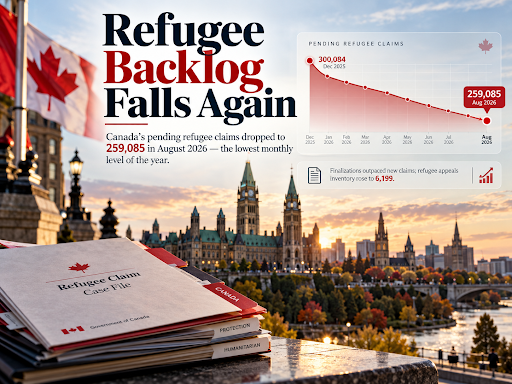
In June alone, the Board finalized 12,985 refugee protection claims while taking in 2,679 new referrals. That pushed the number of pending claims down to 276,649, compared with a peak of more than 300,000 in late 2025.
The decline began gradually before accelerating in the spring.
In January, the Board received 6,490 new claims and finalized 6,668, leaving 299,973 cases pending. February ended with 298,209 pending claims after 5,830 new referrals and 7,594 finalizations.
The gap widened in March, when 5,879 new cases entered the system and 8,586 were completed. The pending total dropped to 295,502.
The biggest shift came after March. New referrals fell below 3,000 a month, while completed claims continued to exceed intake. In April, the Board received 2,657 referrals and finalized 5,110 claims. May brought 2,920 new cases and 9,029 decisions, reducing the pending total to 286,940.
By June, finalizations were almost five times higher than new referrals, producing the largest monthly reduction of the year.
During the first quarter, monthly referrals ranged from about 5,800 to 6,500. From April onward, intake fell to fewer than 3,000 cases a month.
The article linked that drop broadly to policy and border enforcement changes introduced earlier in 2026, including measures that reduced irregular crossings and tightened some intake channels.
Whatever the cause in individual cases, the result is clear: the Refugee Protection Division is now resolving more claims than it receives. That is essential for reducing a backlog of this size.
The improvement does not extend to refugee appeals.
Pending appeals rose every month, from 4,793 in January to 5,706 in June. New appeals also exceeded completed appeals during each month of the period.
In June, the Refugee Appeal Division received 1,197 new appeals and completed 993. April showed one of the widest gaps, with 1,101 new appeals and only 835 finalizations.
The rising appeal caseload means some claimants may receive an initial decision sooner but still face a longer wait if that decision is refused and challenged.
The figures show that faster processing at the first stage does not automatically shorten the entire refugee determination process. Capacity at both divisions matters because unresolved appeals can become the next source of delays for applicants.
For families and individuals waiting for certainty, these separate trends will shape both immediate timelines and the overall length of their cases.
A smaller primary backlog may lead to faster hearings and decisions for people filing new refugee claims in Canada. However, the growing appeals inventory remains a concern.
Applicants should prepare complete, well-supported submissions at the beginning of the process. Clear evidence and accurate documentation can help decision-makers assess a claim properly and may reduce the likelihood of needing to enter the slower appeal stage.









Having an ‘Identity Verified’ badge or being ‘Identity Verified’ simply indicates that an individual has submitted information to complete our identity verification process or we have conducted internal verification using various authorized websites. While this process includes safeguards, it does not guarantee that the person is who they claim to be.
If you encounter any issues with this profile, please report them here. While all consultants who are verified have RCIC ID, we may not have the latest data in terms of their renewal/cancellation/discontinuation of their RCIC ID.
╳The “Verified Consultants” profiles on Immiperts.com are independently compiled using publicly available information from multiple sources, including the official CICC Public Register, consultants’ own websites, other public directories, and social media.
Immiperts.com is a completely independent platform and is not affiliated with, endorsed by, or connected to the College of Immigration and Citizenship Consultants (CICC), IRCC, or any immigration consultant.
All information is collected manually and is for educational and informational purposes only. Consultants may claim, update, or request removal of their profile by contacting us at hello@immiperts.com.
Users are strongly advised to always verify the latest authorization status directly on the official CICC Public Register at college-ic.ca.