



Canada welcomed fewer new permanent residents than expected during the first half of 2026, leaving the federal government behind its annual admissions pace.
Canada is running below its planned permanent resident admissions pace for 2026, according to new data released by Immigration, Refugees and Citizenship Canada.
Between January 1 and June 30, 2026, Canada admitted 155,800 new permanent residents under its main immigration levels plan. That represents about 41% of the annual target of 380,000.
To be halfway toward that target by June 30, Canada would have needed about 190,000 admissions. The country was therefore 34,200 admissions behind pace.
Canada would need to admit another 224,200 permanent residents between July and December to reach the 380,000 target.
Economic immigration accounted for 89,200 permanent resident admissions during the first six months.
Canada’s annual target for the economic category is 239,800, meaning admissions were about 30,700 below the pace needed at mid-year.
The economic category includes programs such as Express Entry, the Provincial Nominee Program, Atlantic Immigration Program, federal business programs and several economic immigration pilots.
Family sponsorship performed differently.
Canada admitted 45,100 permanent residents through family programs by June 30, compared with a full-year target of 84,000.
That puts family-class admissions about 3,100 above the mid-year pace required to meet the annual target.
The category covers sponsored spouses, partners, dependent family members, parents and grandparents.
Canada recorded 17,900 admissions under the refugees and protected persons category during the first half of 2026.
The annual target is 49,300, leaving this category approximately 6,750 admissions behind its expected mid-year pace.
Humanitarian, compassionate and other admissions reached 3,600, slightly ahead of the pace required to reach the annual target of 6,900.
Canada is also operating two one-time permanent residence initiatives for protected persons and certain workers already living in Canada.
For 2026, those initiatives add 46,000 protected-person admissions and 20,000 in-Canada worker admissions on top of the main immigration plan.
That brings Canada’s effective 2026 permanent residence target to 446,000.
By June 30, IRCC had admitted 11,300 in-Canada workers and 15,000 protected persons through these initiatives.
Including these additional admissions, Canada had welcomed 182,100 permanent residents during the first half of the year.
That equals approximately 40.8% of the combined 446,000 target, meaning overall admissions were still behind pace.
IRCC reported that 12,400 French-speaking or bilingual permanent residents were admitted outside Quebec during the first six months.
Canada aims for French-speaking immigrants to represent 9% of permanent resident admissions outside Quebec in 2026.
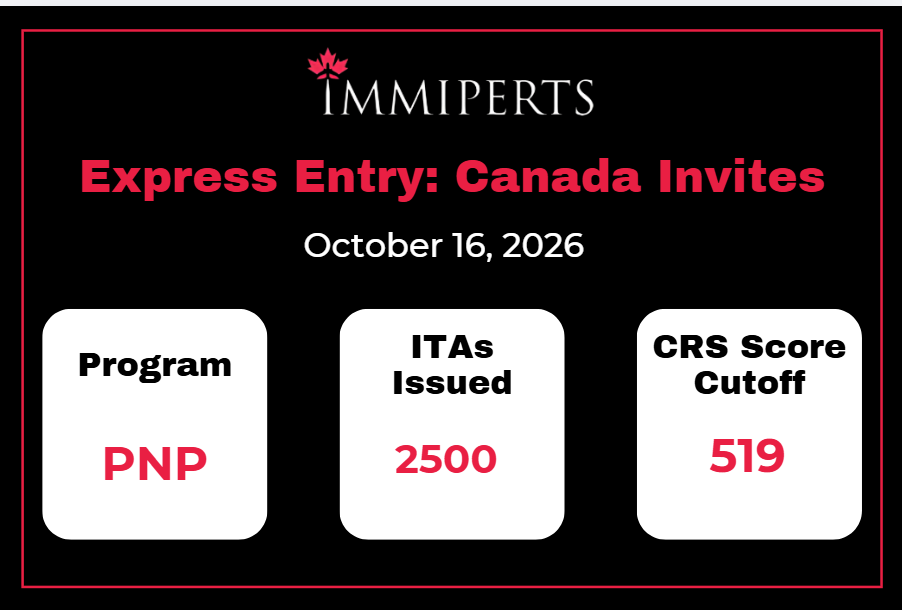
The government has supported that target through French-language Express Entry draws. Of the 114,865 Express Entry invitations issued in 2026, about 39.6% went to French-speaking candidates.
Whether Canada ultimately reaches its annual targets will depend heavily on the pace of admissions during the final six months of 2026.





Having an ‘Identity Verified’ badge or being ‘Identity Verified’ simply indicates that an individual has submitted information to complete our identity verification process or we have conducted internal verification using various authorized websites. While this process includes safeguards, it does not guarantee that the person is who they claim to be.
If you encounter any issues with this profile, please report them here. While all consultants who are verified have RCIC ID, we may not have the latest data in terms of their renewal/cancellation/discontinuation of their RCIC ID.
╳The “Verified Consultants” profiles on Immiperts.com are independently compiled using publicly available information from multiple sources, including the official CICC Public Register, consultants’ own websites, other public directories, and social media.
Immiperts.com is a completely independent platform and is not affiliated with, endorsed by, or connected to the College of Immigration and Citizenship Consultants (CICC), IRCC, or any immigration consultant.
All information is collected manually and is for educational and informational purposes only. Consultants may claim, update, or request removal of their profile by contacting us at hello@immiperts.com.
Users are strongly advised to always verify the latest authorization status directly on the official CICC Public Register at college-ic.ca.