
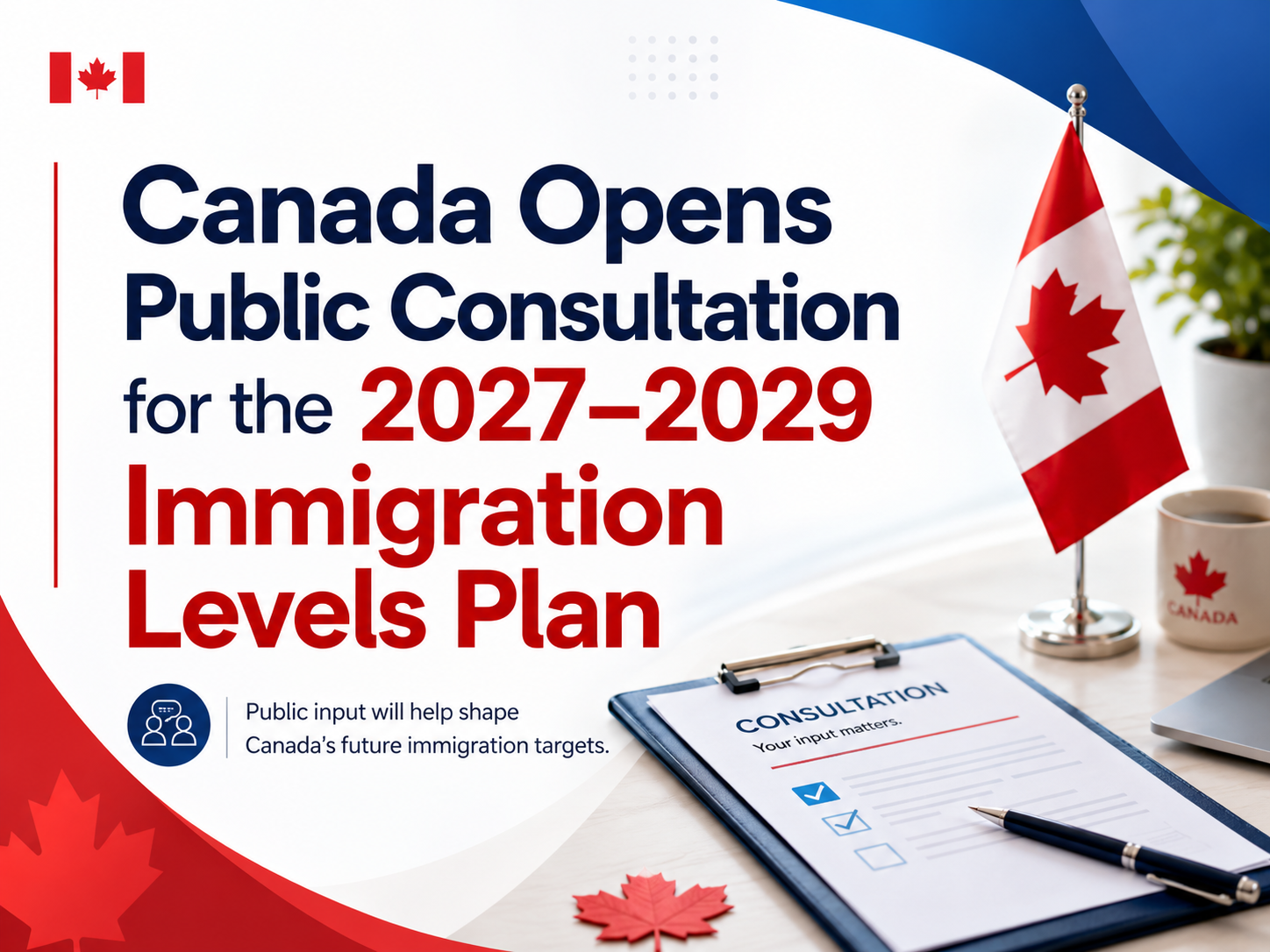


Canada has opened a public consultation on the 2027–2029 immigration levels plan, asking citizens and stakeholders to share views on future targets.
The federal government has launched its public consultation on the 2027–2029 Immigration Levels Plan, inviting Canadians and organisations to provide input on how many newcomers should be welcomed in the next planning period. The online survey opened on May 12, 2026, and will close on June 14, 2026, giving just over a month for submissions. The government plans to table the final Immigration Levels Plan in Parliament by November 2026.
This consultation gives voices from across the country — including individuals, workers, families, businesses, students, and community groups — a chance to influence the future of Canada’s immigration system.
Canada’s immigration system is at a critical decision point as the federal government works to balance economic needs with infrastructure capacity and community well‑being. Recent years saw record growth in temporary residents, and the next plan will shape both temporary resident targets and permanent resident admission levels for the three years ahead.
The government says it wants to ensure that immigration continues to support labour markets, strengthen communities, and build long‑term prosperity, while also aligning with housing, healthcare, and public service capacity.
The online consultation highlights three key targets that have guided recent planning. The government has committed to reducing the share of temporary residents to below 5 % of Canada’s total population by the end of 2027. It also aims to keep permanent resident admissions below 1 % of the population after 2027. Another goal is to raise the share of Francophone newcomers to 12 % of permanent resident admissions by 2029, supporting French‑speaking communities outside Quebec.
Participants in the survey can weigh in on whether these targets should continue, be adjusted upwards or downwards, or be changed in structure and focus.
The consultation survey asks respondents to address several core topics that will influence the next plan:
This structure allows participants to share both general views and specific recommendations about future targets and priorities.
The survey is open to all individuals and organisations with an interest in immigration policy. This includes Canadian citizens and permanent residents, temporary residents such as international students and foreign workers, employers, settlement agencies, municipal governments, advocacy groups, and others involved in immigration‑related work.
Canadians in different regions can highlight local needs, helping to ensure that future plans reflect diverse economic and social conditions across the country.
After the consultation closes on June 14, government officials will review the feedback alongside input gathered from provinces, territories, and ongoing engagement with stakeholders. The results will help shape the 2027–2029 Immigration Levels Plan, which is expected to be tabled in Parliament this fall. Once tabled, the plan will set specific targets for permanent and temporary residents, and help guide immigration policy and planning through 2029.










Having an ‘Identity Verified’ badge or being ‘Identity Verified’ simply indicates that an individual has submitted information to complete our identity verification process or we have conducted internal verification using various authorized websites. While this process includes safeguards, it does not guarantee that the person is who they claim to be.
If you encounter any issues with this profile, please report them here. While all consultants who are verified have RCIC ID, we may not have the latest data in terms of their renewal/cancellation/discontinuation of their RCIC ID.
╳The “Verified Consultants” profiles on Immiperts.com are independently compiled using publicly available information from multiple sources, including the official CICC Public Register, consultants’ own websites, other public directories, and social media.
Immiperts.com is a completely independent platform and is not affiliated with, endorsed by, or connected to the College of Immigration and Citizenship Consultants (CICC), IRCC, or any immigration consultant.
All information is collected manually and is for educational and informational purposes only. Consultants may claim, update, or request removal of their profile by contacting us at hello@immiperts.com.
Users are strongly advised to always verify the latest authorization status directly on the official CICC Public Register at college-ic.ca.