
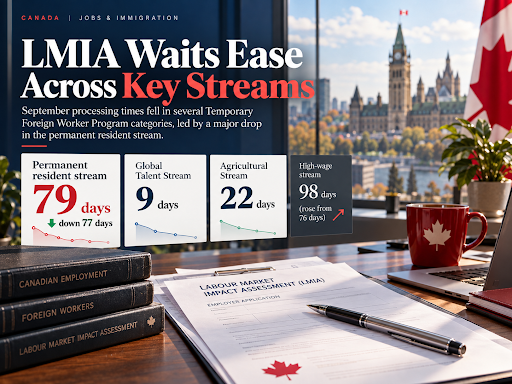


Canada reports shorter LMIA processing times across several foreign worker streams, with the permanent resident stream recording the biggest improvement.
Canada has reported shorter Labour Market Impact Assessment (LMIA) processing times across several Temporary Foreign Worker Program (TFWP) streams in September 2026.
Employment and Social Development Canada (ESDC) released the updated figures on October 7, showing reductions ranging from one to 77 business days.
The permanent resident stream recorded the largest improvement, reaching its shortest processing time of 2026.
However, not every category experienced faster processing, with some employers continuing to face longer waits.
The permanent resident stream experienced the sharpest decline, dropping from 156 business days in August to 79 in September.
The Global Talent Stream improved slightly, falling from 10 to nine days. The agricultural stream also recorded a reduction, moving from 25 to 22 days.
Meanwhile, the high-wage stream increased from 90 to 98 days, reaching its highest level this year.
The Seasonal Agricultural Worker Program rose from six to seven days, ending three consecutive months of declining processing times.
The low-wage stream remained unchanged at 82 days.
These estimates exclude the mandatory recruitment and advertising periods, which can range from 14 days to eight weeks.
Canadian employers generally require a positive or neutral LMIA before hiring foreign workers through the TFWP.
This assessment confirms that employers have met recruitment requirements and that hiring a foreign national is unlikely to negatively affect Canada's labour market.
Before applying, employers must advertise positions and demonstrate reasonable efforts to recruit Canadian citizens or permanent residents.
Once approved, employers provide foreign workers with the LMIA decision letter and employment offer needed for their work permit applications.
An LMIA remains valid for a maximum of six months, meaning workers must submit their applications before expiry.
Some eligible workers may apply while their employer's LMIA assessment remains underway.
Despite improvements in several categories, restrictions remain for certain employers.
Canada suspends low-wage LMIA processing in affected regions where unemployment reaches or exceeds 6%.
The government reviews these regional restrictions quarterly, with the next update scheduled for January 8, 2027.
Employers must therefore check local requirements before beginning recruitment.
The federal government has lowered its TFWP admissions target to 60,000 for 2026, compared with 82,000 in 2025.
Between January and July 2026, Canada admitted 26,735 temporary foreign workers, representing a 31.4% decline from the same period last year.
The International Mobility Program also faces reduced targets, falling from 285,750 in 2025 to 170,000 in 2026.
These changes support Canada's broader goal of reducing temporary residents to below 5% of the population by the end of 2027.
Lower admissions could eventually ease application volumes, although future processing improvements remain uncertain.









Having an ‘Identity Verified’ badge or being ‘Identity Verified’ simply indicates that an individual has submitted information to complete our identity verification process or we have conducted internal verification using various authorized websites. While this process includes safeguards, it does not guarantee that the person is who they claim to be.
If you encounter any issues with this profile, please report them here. While all consultants who are verified have RCIC ID, we may not have the latest data in terms of their renewal/cancellation/discontinuation of their RCIC ID.
╳The “Verified Consultants” profiles on Immiperts.com are independently compiled using publicly available information from multiple sources, including the official CICC Public Register, consultants’ own websites, other public directories, and social media.
Immiperts.com is a completely independent platform and is not affiliated with, endorsed by, or connected to the College of Immigration and Citizenship Consultants (CICC), IRCC, or any immigration consultant.
All information is collected manually and is for educational and informational purposes only. Consultants may claim, update, or request removal of their profile by contacting us at hello@immiperts.com.
Users are strongly advised to always verify the latest authorization status directly on the official CICC Public Register at college-ic.ca.