
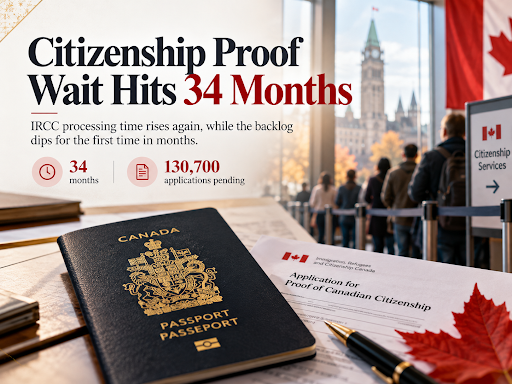


Canada's citizenship certificate processing time has increased again, although the number of pending applications has declined for the first time in months.
Canada's estimated processing time for proof of citizenship applications has reached 34 months, according to Immigration, Refugees and Citizenship Canada (IRCC).
The department updated its figures on October 9, 2026, increasing September's estimate of 33 months by one month.
However, the latest update also brings encouraging news. The number of pending applications has fallen for the first time since Canada expanded its citizenship-by-descent rules in December 2025.
Although the estimated wait continues to increase, October recorded the smallest monthly rise since May.
Processing times climbed from 12 months in May to 15 months in June, 19 months in July, and 25 months in August. September saw the sharpest increase, reaching 33 months.
October's increase represents just 3%, compared with September's 32% jump.
The smaller rise may suggest that processing pressures are beginning to ease, although applicants still face lengthy waits.
IRCC reported 130,700 applications awaiting decisions in October, compared with 136,000 in September.
The reduction of 5,300 applications marks a significant change after several months of growing backlogs.
August alone saw an increase of 22,300 pending files, followed by another 14,200 in September.
The latest decline indicates that IRCC completed more applications than it received during the reporting period.
However, the department has not explained what caused the improvement. Further reductions would be needed to establish a lasting trend.
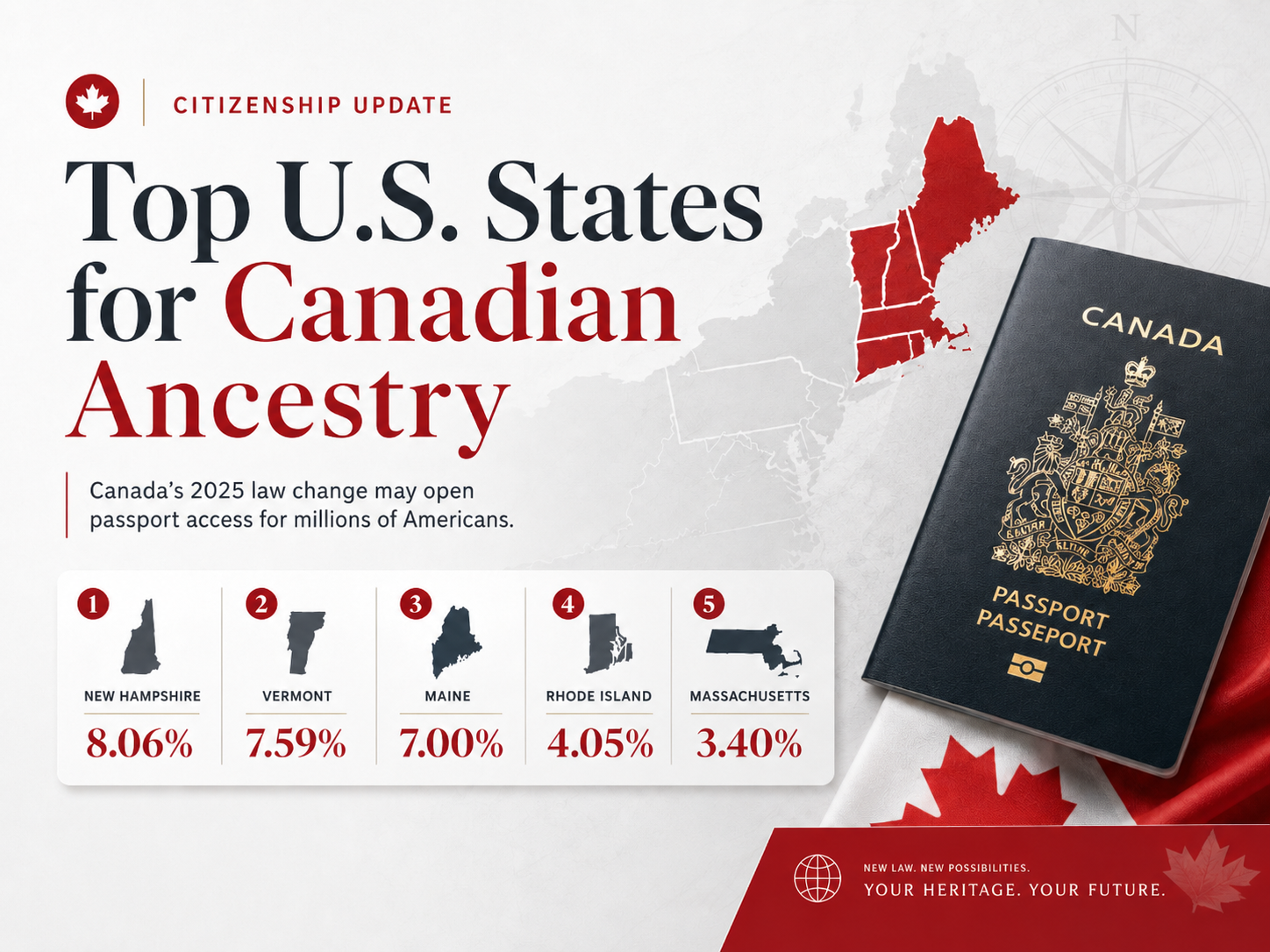
Canada introduced significant citizenship changes through Bill C-3 on December 15, 2025.
The legislation removed the first-generation restriction for eligible people born abroad before that date.
As a result, some individuals with Canadian grandparents, great-grandparents, or more distant ancestors may already qualify as Canadian citizens.
This expanded eligibility encouraged additional applications, particularly among people living outside Canada.
Eligible individuals must provide documents establishing their citizenship through family connections.
IRCC allows urgent processing in certain circumstances, including employment difficulties, educational requirements, serious family emergencies, and other qualifying situations.
Applicants must explain their circumstances and submit supporting evidence, such as employer letters, medical documents, or travel records.
Meeting urgent processing requirements does not guarantee faster approval.
Submitting complete documents, resolving name discrepancies, and explaining missing family records can also help applicants avoid unnecessary delays.
IRCC calculates estimated processing times using pending applications, available staff, and expected submission volumes.
Applicants considering citizenship certificates should understand that delaying an application does not necessarily shorten their wait.
The certificate confirms existing Canadian citizenship rather than granting new citizenship.
For eligible individuals, obtaining this document is an important step towards applying for a Canadian passport.









Having an ‘Identity Verified’ badge or being ‘Identity Verified’ simply indicates that an individual has submitted information to complete our identity verification process or we have conducted internal verification using various authorized websites. While this process includes safeguards, it does not guarantee that the person is who they claim to be.
If you encounter any issues with this profile, please report them here. While all consultants who are verified have RCIC ID, we may not have the latest data in terms of their renewal/cancellation/discontinuation of their RCIC ID.
╳The “Verified Consultants” profiles on Immiperts.com are independently compiled using publicly available information from multiple sources, including the official CICC Public Register, consultants’ own websites, other public directories, and social media.
Immiperts.com is a completely independent platform and is not affiliated with, endorsed by, or connected to the College of Immigration and Citizenship Consultants (CICC), IRCC, or any immigration consultant.
All information is collected manually and is for educational and informational purposes only. Consultants may claim, update, or request removal of their profile by contacting us at hello@immiperts.com.
Users are strongly advised to always verify the latest authorization status directly on the official CICC Public Register at college-ic.ca.