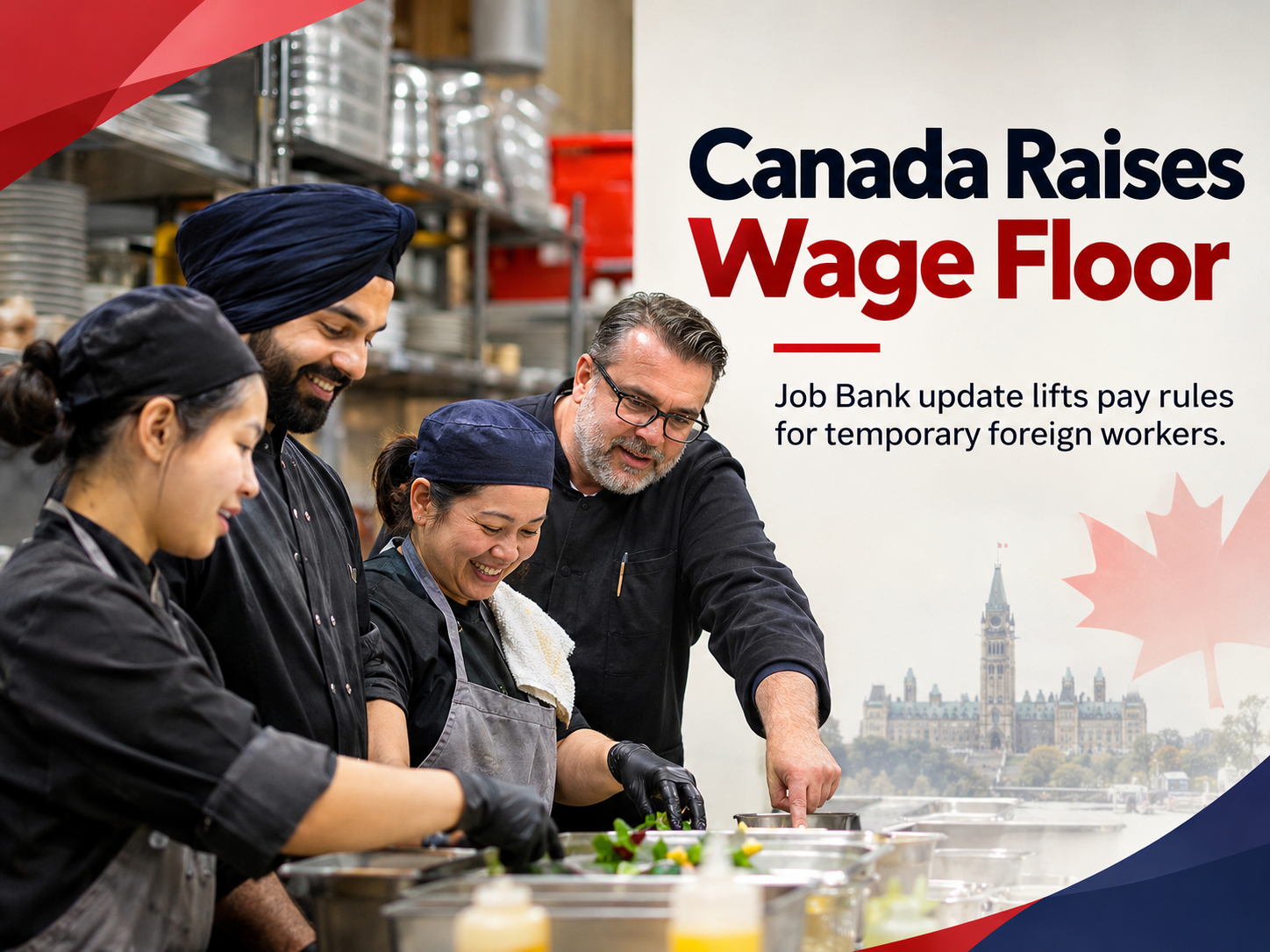


Canada's latest Job Bank update increases wage requirements across most occupations, giving employers until January 1, 2027, to adjust existing workers' pay.
Canada's latest Job Bank wage update is bringing higher pay requirements for thousands of temporary foreign workers, with employers facing a January 1, 2027, deadline to review existing salaries.
Released on November 18, 2026, the update shows that median hourly wages increased in 414 of 497 occupations compared with last year. That means 83.3% of the occupations studied recorded wage growth.
Across the 497 occupations, the average national median hourly wages increased by 3.7%, rising from $34.13 in 2025 to $35.39 in 2026.
While 414 occupations recorded increases, 53 experienced declines and 30 remained unchanged.
Every province and territory reported growth in its average occupational median wage.
Yukon recorded the largest percentage increase at 6%, followed by Ontario at 3.6%, Newfoundland and Labrador at 3.5%, and Nova Scotia at 3.4%.
British Columbia's average reached $37.08, while Ontario's climbed to $35.61. Alberta recorded $36.57, and Manitoba reached $33.00.
These figures represent averages across occupations, not the typical earnings of individual workers.
Employers participating in the Temporary Foreign Worker Program (TFWP) must review their workers' wages annually.
Existing employees earning below the updated prevailing wage must receive the required adjustment by January 1, 2027.
New foreign workers must receive the applicable prevailing wage from their first day, even when an earlier Labour Market Impact Assessment (LMIA) lists a lower amount.
The prevailing wage is whichever is higher: the regional Job Bank median or the employer's pay for comparable employees.
Employers failing to meet these requirements risk financial penalties or restrictions on hiring foreign workers.
The updated requirements generally cover workers in high-wage and low-wage TFWP streams, the Global Talent Stream, and in-home caregiver positions.
Employers cannot reduce an employee's wages below the amount approved in their LMIA, even when regional prevailing wages decline.
Quebec employers must follow provincial wage tables published by the immigration ministry.
The changes also affect applications for renewed work permits where a new LMIA is required.
However, the update does not change the separate wage thresholds determining whether jobs belong to high-wage or low-wage streams.
The wage adjustments arrive as Canada reduces planned temporary foreign worker admissions.
The government set a target of 60,000 admissions for 2026, compared with 82,000 in 2025. The target falls further to 50,000 in 2027.
Between January and September 2026, Canada admitted 31,875 workers through the program, representing a 32.3% decline from the same period in 2025.
Recent restrictions also include tighter LMIA processing rules and lower hiring limits for many employers.
The Job Bank revisions could eventually influence which occupations qualify for additional Express Entry points under the high-wage criteria introduced on November 3.
However, the November 18 wage update does not immediately change Comprehensive Ranking System scores or the current list of eligible occupations.
Future reviews could alter eligibility as newer wage information becomes available.
For now, employers must focus on reviewing wages and meeting the January deadline.





Having an ‘Identity Verified’ badge or being ‘Identity Verified’ simply indicates that an individual has submitted information to complete our identity verification process or we have conducted internal verification using various authorized websites. While this process includes safeguards, it does not guarantee that the person is who they claim to be.
If you encounter any issues with this profile, please report them here. While all consultants who are verified have RCIC ID, we may not have the latest data in terms of their renewal/cancellation/discontinuation of their RCIC ID.
╳The “Verified Consultants” profiles on Immiperts.com are independently compiled using publicly available information from multiple sources, including the official CICC Public Register, consultants’ own websites, other public directories, and social media.
Immiperts.com is a completely independent platform and is not affiliated with, endorsed by, or connected to the College of Immigration and Citizenship Consultants (CICC), IRCC, or any immigration consultant.
All information is collected manually and is for educational and informational purposes only. Consultants may claim, update, or request removal of their profile by contacting us at hello@immiperts.com.
Users are strongly advised to always verify the latest authorization status directly on the official CICC Public Register at college-ic.ca.