
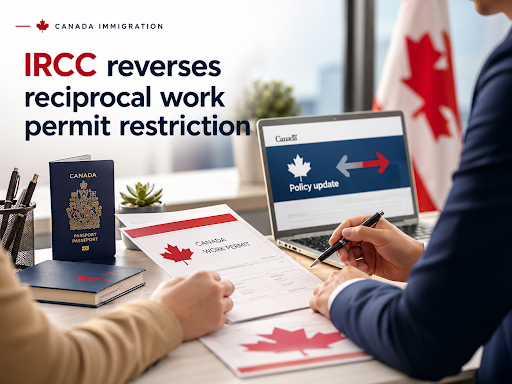


Canada has corrected instructions that would have restricted access to certain LMIA-exempt work permits.
Canada’s immigration department has withdrawn a restriction that would have limited some reciprocal employment work permits to people already working for a company outside Canada.
Immigration, Refugees and Citizenship Canada corrected its online instructions on August 6, 2026. The department removed wording that said an applicant had to be a current employee of the overseas company before coming to Canada.
The restriction first appeared in updated guidance for immigration officers published on July 29, 2026. Under that wording, a foreign national could not receive the permit when the Canadian job was scheduled to begin only after the person arrived in the country.
An IRCC official later said the change “was posted in error due to a version control issue and does not reflect the intended policy.” The statement was shared in an email circulated among immigration lawyers.
The corrected instructions no longer say that workers “must be currently employed by the company abroad.” This means applicants are not automatically excluded simply because their employment with the organization is set to start in Canada.
These permits are issued under the International Mobility Program using exemption code C20. The program allows Canadian employers to hire certain foreign workers without first obtaining a Labour Market Impact Assessment, commonly called an LMIA.
An LMIA is normally used under the Temporary Foreign Worker Program to assess whether hiring a foreign worker could affect employment opportunities for Canadians. Since C20 permits do not require this assessment, employers may face fewer steps, lower costs and a more direct application process.
However, applicants and employers must still meet the rules for the reciprocal employment category. IRCC officers must be satisfied that the Canadian position creates or maintains similar work opportunities abroad for Canadian citizens or permanent residents.
IRCC’s current guidance says reciprocity does not need to involve a direct one-for-one exchange between two countries. A multinational employer, for example, may show that it offers comparable opportunities to Canadians at offices in several countries.
Employers should explain the reciprocal arrangement in the job offer. Applicants may also need to provide documents showing how the position meets the category’s requirements. Officers can review exchange agreements, letters from Canadian institutions, employment offers and records showing the number and types of workers moving between locations.
The number of Canadian and foreign workers does not have to match exactly. Officers may consider the size of the exchange, the length of employment and the level of the jobs involved.
Reciprocal employment permits are often used by multinational companies, international non-profit groups, academic institutions, sports organizations and government bodies operating across borders.
The August 6 correction restores the broader approach reflected in the intended policy. Applicants will still need to prove that genuine reciprocal employment exists, but current overseas employment is no longer listed as a mandatory condition.
The clarification is important for organizations planning international assignments and hiring workers for Canadian roles.












Having an ‘Identity Verified’ badge or being ‘Identity Verified’ simply indicates that an individual has submitted information to complete our identity verification process or we have conducted internal verification using various authorized websites. While this process includes safeguards, it does not guarantee that the person is who they claim to be.
If you encounter any issues with this profile, please report them here. While all consultants who are verified have RCIC ID, we may not have the latest data in terms of their renewal/cancellation/discontinuation of their RCIC ID.
╳The “Verified Consultants” profiles on Immiperts.com are independently compiled using publicly available information from multiple sources, including the official CICC Public Register, consultants’ own websites, other public directories, and social media.
Immiperts.com is a completely independent platform and is not affiliated with, endorsed by, or connected to the College of Immigration and Citizenship Consultants (CICC), IRCC, or any immigration consultant.
All information is collected manually and is for educational and informational purposes only. Consultants may claim, update, or request removal of their profile by contacting us at hello@immiperts.com.
Users are strongly advised to always verify the latest authorization status directly on the official CICC Public Register at college-ic.ca.