



Nova Scotia and Quebec have agreed to follow a new federal policy that allows rural employers to bring in more temporary foreign workers to fill job gaps.
Nova Scotia and Quebec have become the first provinces to adopt a new federal policy aimed at helping rural employers hire and retain temporary foreign workers in lower-paying roles. The policy gives more flexibility to businesses that struggle to find local workers.
In this case, “rural” refers to areas outside major cities, based on official national data.
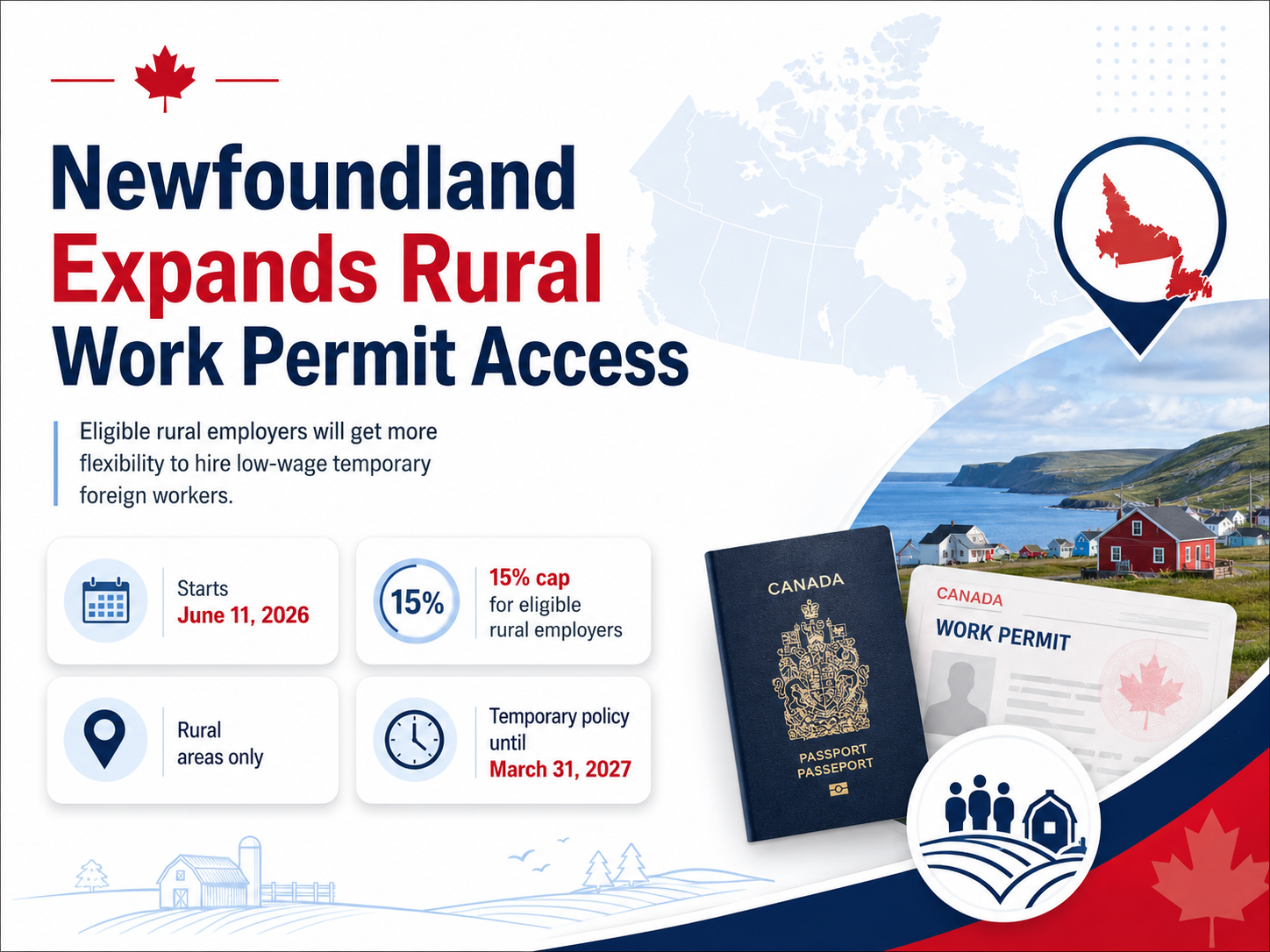
The federal government introduced this temporary policy on April 1. It allows certain rural employers to keep a higher number of temporary foreign workers in low-wage jobs.
Employers can now maintain their current share of these workers, even if it already exceeds the usual 10 per cent limit. In some cases, they may also raise that limit to 15 per cent.
However, these changes apply only in provinces and territories that agree to take part.
Nova Scotia will roll out both parts of the policy starting April 14, 2026. Employers across all industries in rural areas will benefit.
Businesses in the province can keep their existing number of temporary foreign workers, even if it goes beyond the cap. They can also use the higher 15 per cent limit instead of the standard 10 per cent.
Quebec has chosen to apply only one part of the policy so far. Since April 1, 2026, rural employers in the province can keep their current share of temporary foreign workers at a worksite, even if it exceeds the usual cap.
The province has not yet confirmed whether it will allow the higher 15 per cent limit.
Not every employer will qualify automatically. Businesses must still follow all standard program rules. They need to show that they tried to hire Canadian citizens or permanent residents before turning to foreign workers.
The policy applies only to applications submitted while the measures remain active. Officials plan to keep the program in place until March 31, 2027.
Certain job categories linked to permanent residence applications do not fall under these new rules.
Several provinces and territories, including Ontario, Alberta, and British Columbia, have not yet confirmed whether they will join the program. Officials say they will share updates as more regions respond.
The policy does not affect industries that already follow a different rule. Sectors such as construction, food manufacturing, hospitals, and long-term care facilities can still hire up to 20 per cent temporary foreign workers in low-wage roles.
Rural employers often face ongoing labour shortages. Many struggle to fill lower-paying jobs with local workers. This policy gives them more room to meet their staffing needs.
For foreign workers, the changes may open up more job opportunities in smaller communities. However, access will depend on where the policy applies and whether employers meet all conditions.











Having an ‘Identity Verified’ badge or being ‘Identity Verified’ simply indicates that an individual has submitted information to complete our identity verification process or we have conducted internal verification using various authorized websites. While this process includes safeguards, it does not guarantee that the person is who they claim to be.
If you encounter any issues with this profile, please report them here. While all consultants who are verified have RCIC ID, we may not have the latest data in terms of their renewal/cancellation/discontinuation of their RCIC ID.
╳The “Verified Consultants” profiles on Immiperts.com are independently compiled using publicly available information from multiple sources, including the official CICC Public Register, consultants’ own websites, other public directories, and social media.
Immiperts.com is a completely independent platform and is not affiliated with, endorsed by, or connected to the College of Immigration and Citizenship Consultants (CICC), IRCC, or any immigration consultant.
All information is collected manually and is for educational and informational purposes only. Consultants may claim, update, or request removal of their profile by contacting us at hello@immiperts.com.
Users are strongly advised to always verify the latest authorization status directly on the official CICC Public Register at college-ic.ca.