
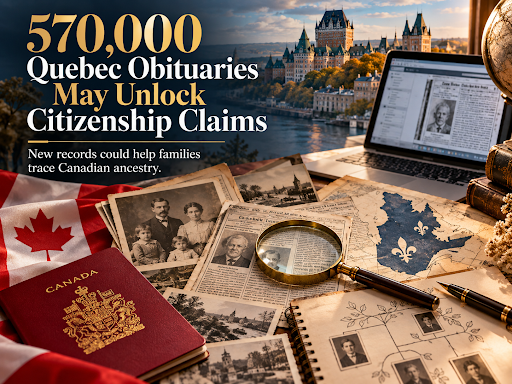


A newly added Quebec obituary index may help families trace records needed for Canadian citizenship claims.
A major collection of Quebec obituary records has become easier to search, giving people with French-Canadian ancestry another way to trace family connections that may support a Canadian citizenship claim.
The newly available index contains 570,090 obituaries published in Quebec newspapers between 1902 and 2025. The records were compiled by the Drouin Institute and added to a large genealogy database on September 23.
The timing could be important for some families. Changes introduced under Bill C-3 in December 2025 removed Canada's previous first-generation limit on citizenship by descent. That limit had prevented many Canadians born outside the country from passing citizenship to children who were also born abroad.
An obituary does not prove Canadian citizenship by itself. However, it can help families identify the official records needed to build a citizenship application.
People seeking proof of citizenship must usually document the connection between themselves and a Canadian parent, grandparent or earlier ancestor.
Obituaries can provide useful clues, including birthplaces, parents' names, spouses, children and other relatives. Those details can help applicants locate birth certificates, marriage records and other documents issued by government authorities.
Federal immigration officials have made clear that citizenship applications cannot rely only on third-party records. Applicants still need official evidence from sources such as civil registries or vital statistics offices.
Still, obituary information can show where those records may exist and which family connections need to be documented.
The collection may be particularly useful for families whose names changed after moving between Canada and the United States.
Some French-Canadian surnames were translated or changed over time. For example, a family name such as Boisvert may have later appeared as Greenwood.
An obituary that lists relatives using different versions of a surname can help connect generations that might otherwise appear unrelated in official searches.
Marriage records can also help explain name changes, particularly for women who used a married surname.
Obituaries may also reveal siblings, children and grandchildren. That means one family discovery could potentially help several relatives who share the same Canadian ancestor.
Entries in the collection may contain a person's name, age, date and place of birth, death information, burial details and cemetery name.
Some records also list spouses, parents, children and other relatives.
The index covers Quebec newspapers, and many of the records are written in French. The database does not include images of the original newspaper notices.
The original archive is much larger. By late 2019, the Drouin Institute's obituary collection contained about 678,000 records. Its current genealogy database lists roughly 1.67 million obituaries, mainly from Quebec and Ontario.
Users can search the obituary indexes without paying, but access to full records is limited.
Free searches may confirm that an ancestor appears in the collection and provide basic information. More detailed information, including some dates, family relationships and full record images, generally requires paid access.
Even a basic search, however, may give families enough information to begin tracking down official documents needed for a citizenship application.











Having an ‘Identity Verified’ badge or being ‘Identity Verified’ simply indicates that an individual has submitted information to complete our identity verification process or we have conducted internal verification using various authorized websites. While this process includes safeguards, it does not guarantee that the person is who they claim to be.
If you encounter any issues with this profile, please report them here. While all consultants who are verified have RCIC ID, we may not have the latest data in terms of their renewal/cancellation/discontinuation of their RCIC ID.
╳The “Verified Consultants” profiles on Immiperts.com are independently compiled using publicly available information from multiple sources, including the official CICC Public Register, consultants’ own websites, other public directories, and social media.
Immiperts.com is a completely independent platform and is not affiliated with, endorsed by, or connected to the College of Immigration and Citizenship Consultants (CICC), IRCC, or any immigration consultant.
All information is collected manually and is for educational and informational purposes only. Consultants may claim, update, or request removal of their profile by contacting us at hello@immiperts.com.
Users are strongly advised to always verify the latest authorization status directly on the official CICC Public Register at college-ic.ca.