
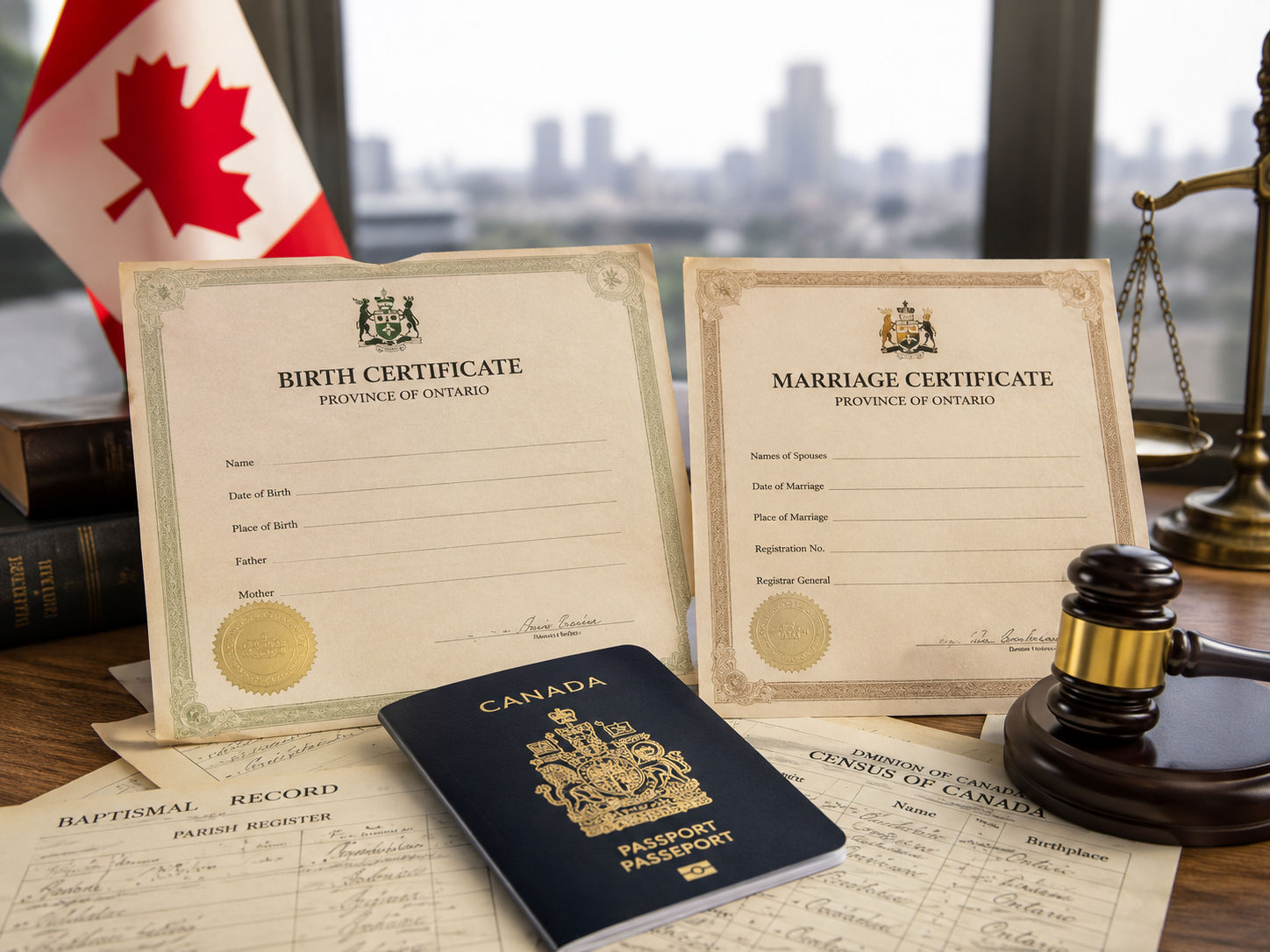


Birth and marriage records often provide the strongest links in a Canadian citizenship by descent application.
People applying for proof of Canadian citizenship by descent may need to collect several records, but two types of documents often carry the greatest value: birth records and marriage certificates.
Together, these records can prove family relationships, confirm where someone was born and explain changes in names between generations. They can also direct applicants toward the next document needed to establish an unbroken family line connecting them to a Canadian ancestor.
Immigration, Refugees and Citizenship Canada tightened its documentation requirements in June 2026.
Documents must now come from the original authority that created or maintained the record, such as a provincial vital statistics office, civil registry or government archive. Records downloaded from genealogy websites may help with research, but IRCC will not accept an application supported only by third-party copies.
This requirement may create additional challenges for applicants seeking records from older generations, particularly when certificates are held in archives or must be formally reissued.
A Canadian birth certificate can perform two important functions. It may prove the relationship between a child and their parents while also showing that the person was born in Canada.
Canada generally grants citizenship to people born on Canadian soil, although limited exceptions apply, including some children born to foreign diplomats.
Long-form birth certificates are usually more useful because they include the parents’ names. Short-form certificates may leave out this information.
When no civil birth certificate exists, IRCC may consider certified records from the original issuing authority. These can include baptismal records created soon after birth, hospital documents, records from a physician or midwife, census entries and passenger manifests.
Quebec records have additional requirements. IRCC generally accepts Quebec birth and marriage certificates only when a Quebec authority issued them after January 1, 1994. The relevant date is when the certificate was printed, not when the birth or marriage occurred.
Older events may still be documented through a certified reproduction from Bibliothèque et Archives nationales du Québec or a certificate reissued by the Directeur de l’état civil.
Marriage certificates are especially important when a person appears under different names across family records.
For example, a woman may appear under her birth surname on one document and her married surname on her child’s birth certificate. The marriage record connects those identities and helps confirm that the documents refer to the same person.
Marriage records may also show changes in surname spelling after a family settled in an English-speaking community. In some cases, both spellings appear in the same record.
Marriage certificates can also be primary evidence in specific historical citizenship cases. This includes some women who married Canadian-born or naturalized British subjects before January 1, 1947, or before April 1, 1949, in Newfoundland and Labrador.
When a record cannot be found, applicants must do more than provide a written explanation.
IRCC now expects proof that the applicant made a genuine effort to obtain it. Evidence may include correspondence with an archive or a formal no-record letter from a vital statistics office.
In a simple example, an Ontario birth certificate could prove that a grandmother was Canadian. Her marriage certificate could show her change of surname, while her child’s and grandchild’s birth certificates would complete the family chain.
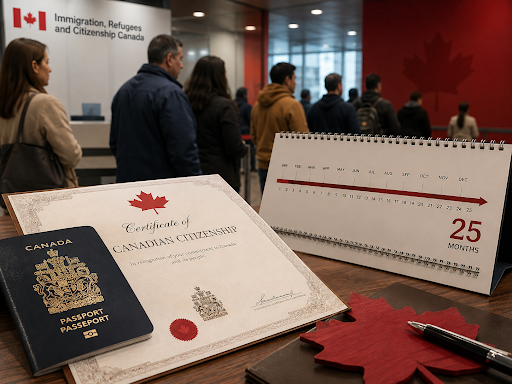
Processing times have also increased. According to IRCC’s July 7, 2026 update, proof of citizenship applications were taking about 19 months, compared with roughly nine months in November 2025. Nearly 29,000 certificates were issued between January and May 2026, while more than 82,000 applications remained in the inventory.








Having an ‘Identity Verified’ badge or being ‘Identity Verified’ simply indicates that an individual has submitted information to complete our identity verification process or we have conducted internal verification using various authorized websites. While this process includes safeguards, it does not guarantee that the person is who they claim to be.
If you encounter any issues with this profile, please report them here. While all consultants who are verified have RCIC ID, we may not have the latest data in terms of their renewal/cancellation/discontinuation of their RCIC ID.
╳The “Verified Consultants” profiles on Immiperts.com are independently compiled using publicly available information from multiple sources, including the official CICC Public Register, consultants’ own websites, other public directories, and social media.
Immiperts.com is a completely independent platform and is not affiliated with, endorsed by, or connected to the College of Immigration and Citizenship Consultants (CICC), IRCC, or any immigration consultant.
All information is collected manually and is for educational and informational purposes only. Consultants may claim, update, or request removal of their profile by contacting us at hello@immiperts.com.
Users are strongly advised to always verify the latest authorization status directly on the official CICC Public Register at college-ic.ca.