
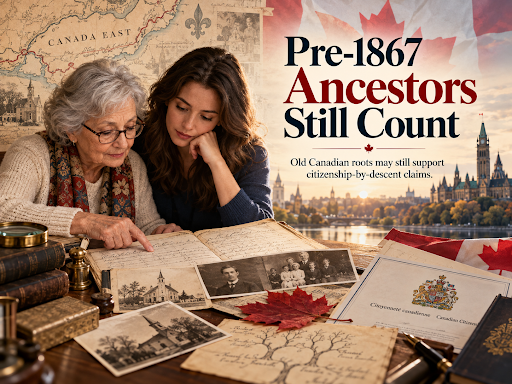


A Canadian ancestor born before Confederation may still matter in a citizenship-by-descent claim.
People tracing Canadian citizenship through distant ancestors may assume that their family line must begin after Confederation in 1867. However, current Canadian citizenship law does not expressly establish 1867 as the earliest date from which an ancestry-based claim can be considered.
That distinction has become more important since Bill C-3 changed Canada’s citizenship-by-descent rules on December 15, 2025. The legislation removed the previous first-generation limit in certain cases, potentially allowing some people with more distant Canadian ancestry to receive recognition as citizens.
Consider an ancestor born in Canada East, now Quebec, in 1850.
At first glance, that date may seem too early because Canada did not officially form through Confederation until July 1, 1867. However, the Citizenship Act does not simply state that an ancestor must have been born after Confederation.
Lawyers examining pre-Confederation cases argue that the more important questions concern where the ancestor lived or was born and what legal status applied to that person.
The Canadian Immigration Lawyers Association published an analysis in August 2026 arguing that the Constitution Act, 1867 supports legal continuity between the former Province of Canada and the provinces of Ontario and Quebec. Its authors say this can support certain claims involving ancestors who lived in those territories before Confederation.
However, they also acknowledge an important limitation: Canadian courts have not yet decided this specific issue in a citizenship case. The interpretation therefore remains legally arguable rather than conclusively settled.
Another complication arises when an ancestor died before modern Canadian citizenship formally began in 1947.
Section 3(1.3) of the Citizenship Act addresses certain situations where a parent died before January 1, 1947. It asks whether that person would have become a Canadian citizen if the 1946 Canadian Citizenship Act had come into force immediately before their death.
This provision can effectively bridge some historical gaps caused by an ancestor dying before Canadian citizenship existed in its modern legal form.
However, it does not mean every person with an ancestor who died before 1947 automatically qualifies. The facts of each generation and the historical citizenship rules still matter.
For older ancestry claims, proving the family line can be more difficult than dealing with the year 1867 itself.
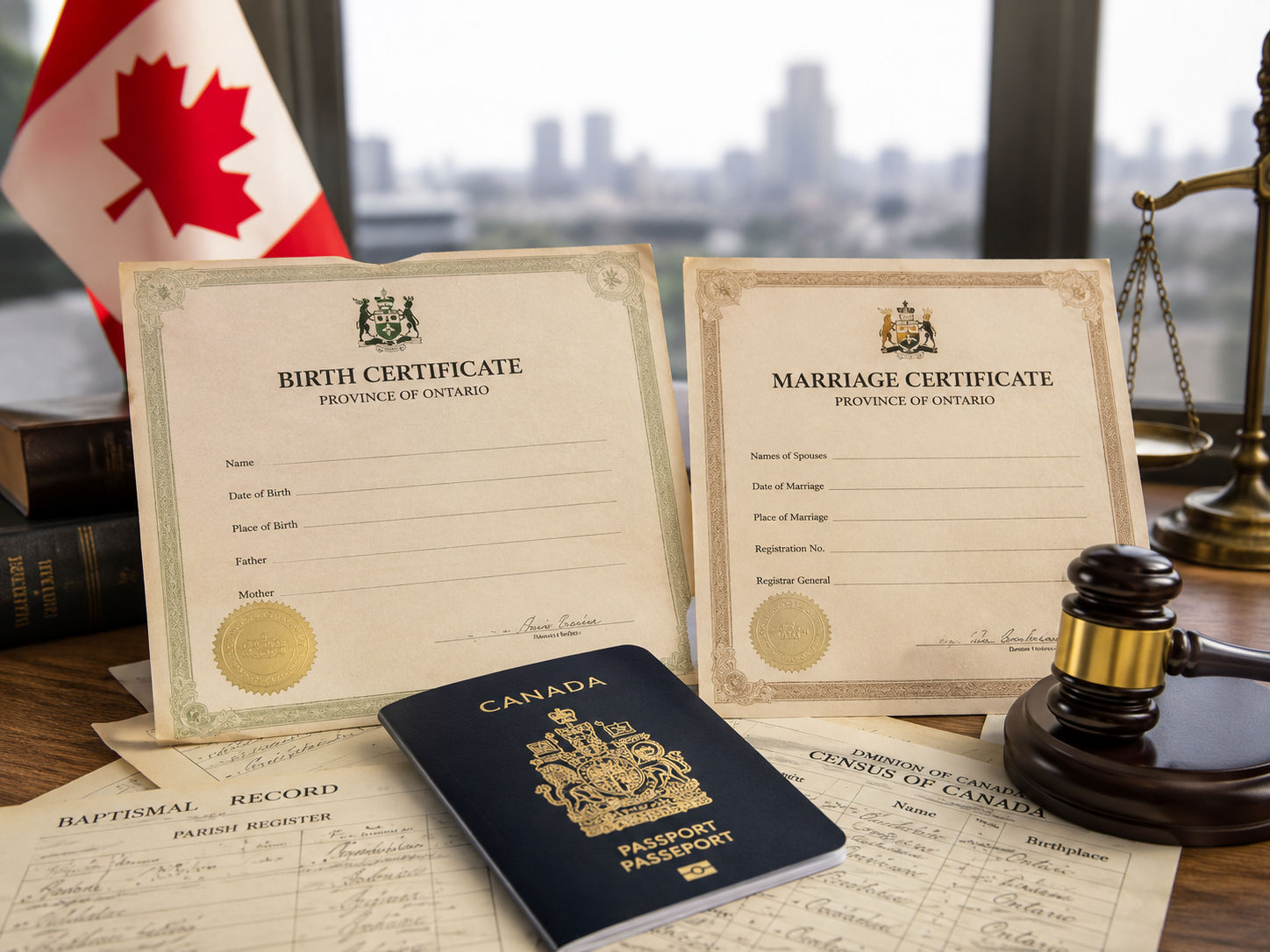
Applicants may need birth, baptismal, marriage, death and other historical records for every generation connecting them to the relevant ancestor.
For very old Canadian records, modern birth certificates may not exist. Parish registers and archived documents can become important evidence.
Each extra generation can also introduce name changes, missing documents and conflicting information that must be resolved.
Bill C-3, which came into effect on December 15, 2025, changed the first-generation limit on citizenship by descent. IRCC says people who believe the new law made them Canadian can apply for a citizenship certificate, which the department uses to formally determine whether they are citizens.
For people tracing ancestry to Canada before Confederation, the practical question is therefore not simply whether an ancestor was born before 1867.
The stronger question is whether Canadian law recognizes the relevant ancestral connection and whether the applicant can document every necessary link.








Having an ‘Identity Verified’ badge or being ‘Identity Verified’ simply indicates that an individual has submitted information to complete our identity verification process or we have conducted internal verification using various authorized websites. While this process includes safeguards, it does not guarantee that the person is who they claim to be.
If you encounter any issues with this profile, please report them here. While all consultants who are verified have RCIC ID, we may not have the latest data in terms of their renewal/cancellation/discontinuation of their RCIC ID.
╳The “Verified Consultants” profiles on Immiperts.com are independently compiled using publicly available information from multiple sources, including the official CICC Public Register, consultants’ own websites, other public directories, and social media.
Immiperts.com is a completely independent platform and is not affiliated with, endorsed by, or connected to the College of Immigration and Citizenship Consultants (CICC), IRCC, or any immigration consultant.
All information is collected manually and is for educational and informational purposes only. Consultants may claim, update, or request removal of their profile by contacting us at hello@immiperts.com.
Users are strongly advised to always verify the latest authorization status directly on the official CICC Public Register at college-ic.ca.