
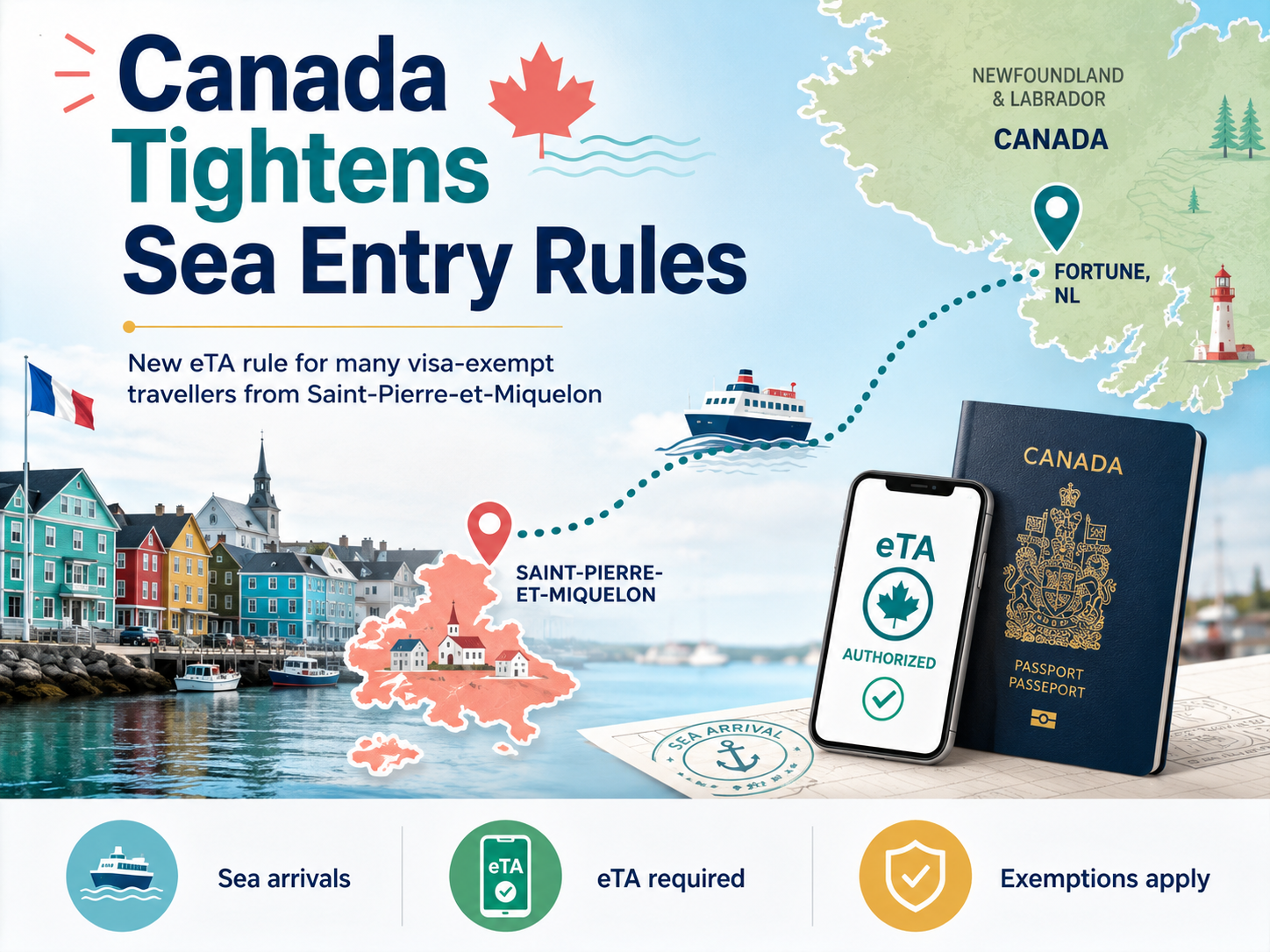


Most visa-exempt travellers arriving by sea from Saint-Pierre-et-Miquelon now need an eTA.
Canada has introduced a new entry rule for many visa-exempt travellers arriving by sea from Saint-Pierre-et-Miquelon.
Most travellers from the French territory now need an electronic travel authorization, known as an eTA, before entering Canada by sea. The requirement applies to those travelling by ferry, commercial vessels, and private boats.
The change took effect at 1 a.m. EDT on June 5, 2026.
Canada usually requires eTAs for visa-exempt foreign nationals who fly to Canada or transit through a Canadian airport.
The new rule extends that requirement to many travellers arriving by sea from Saint-Pierre-et-Miquelon. This is a notable change because sea travel has not usually been treated the same way as air travel for eTA screening.
The measure affects people travelling between Saint-Pierre-et-Miquelon and Canada, including those arriving in Fortune, Newfoundland and Labrador.
The federal government said the change was introduced because some foreign nationals were trying to avoid Canada’s pre-arrival screening rules by travelling by boat.
According to the government’s press release, the concern involved people travelling between Saint-Pierre-et-Miquelon and Fortune, Newfoundland and Labrador, in an attempt to bypass screening requirements.
The new policy is meant to close that gap and ensure more travellers are checked before arriving in Canada.
Not everyone arriving by sea from Saint-Pierre-et-Miquelon needs an eTA under the new rule.
The exemption applies to cruise ship passengers. Seafarers working on commercial vessels, such as fishing boats, are also exempt.
U.S. citizens and U.S. permanent residents do not need an eTA under this change.
French citizens who live in Saint-Pierre-et-Miquelon and travel directly to Canada are also exempt.
These exemptions are important because the policy does not apply equally to every person travelling from the territory.
The government said there are no changes for travellers from visa-required countries.
That means people who already need a visa to enter Canada must continue to follow the existing visa rules. The new measure mainly affects visa-exempt travellers who may not have previously needed an eTA when arriving by sea.
An eTA is a digital travel authorization linked to a traveller’s passport.
Foreign nationals usually apply for an eTA online. In many cases, it is issued within minutes, though travellers should apply before making final travel plans in case extra review is needed.
Once approved, an eTA is generally valid for up to five years, or until the passport expires, whichever comes first.
Travellers should make sure their passport details are correct when applying, because the eTA is electronically connected to that passport.
Anyone planning to travel by sea from Saint-Pierre-et-Miquelon to Canada should confirm whether the new rule applies to them before departure.
The change means many travellers who previously entered by sea without an eTA may now need one before they can board or arrive.
The new rule is part of Canada’s effort to strengthen pre-arrival screening and manage sea-border entry more closely.













Having an ‘Identity Verified’ badge or being ‘Identity Verified’ simply indicates that an individual has submitted information to complete our identity verification process or we have conducted internal verification using various authorized websites. While this process includes safeguards, it does not guarantee that the person is who they claim to be.
If you encounter any issues with this profile, please report them here. While all consultants who are verified have RCIC ID, we may not have the latest data in terms of their renewal/cancellation/discontinuation of their RCIC ID.
╳The “Verified Consultants” profiles on Immiperts.com are independently compiled using publicly available information from multiple sources, including the official CICC Public Register, consultants’ own websites, other public directories, and social media.
Immiperts.com is a completely independent platform and is not affiliated with, endorsed by, or connected to the College of Immigration and Citizenship Consultants (CICC), IRCC, or any immigration consultant.
All information is collected manually and is for educational and informational purposes only. Consultants may claim, update, or request removal of their profile by contacting us at hello@immiperts.com.
Users are strongly advised to always verify the latest authorization status directly on the official CICC Public Register at college-ic.ca.