
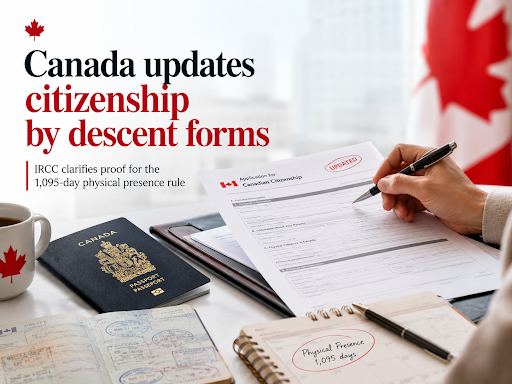


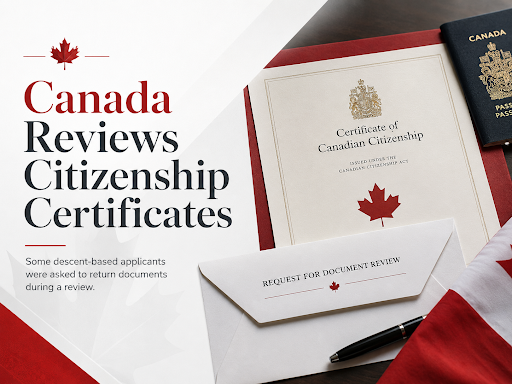
IRCC has clarified how some Canadians must prove a parent’s physical presence in Canada.
Immigration, Refugees and Citizenship Canada has updated documents for proof-of-citizenship applications, adding clearer rules for Canadians by descent who must show a parent’s time spent in Canada.
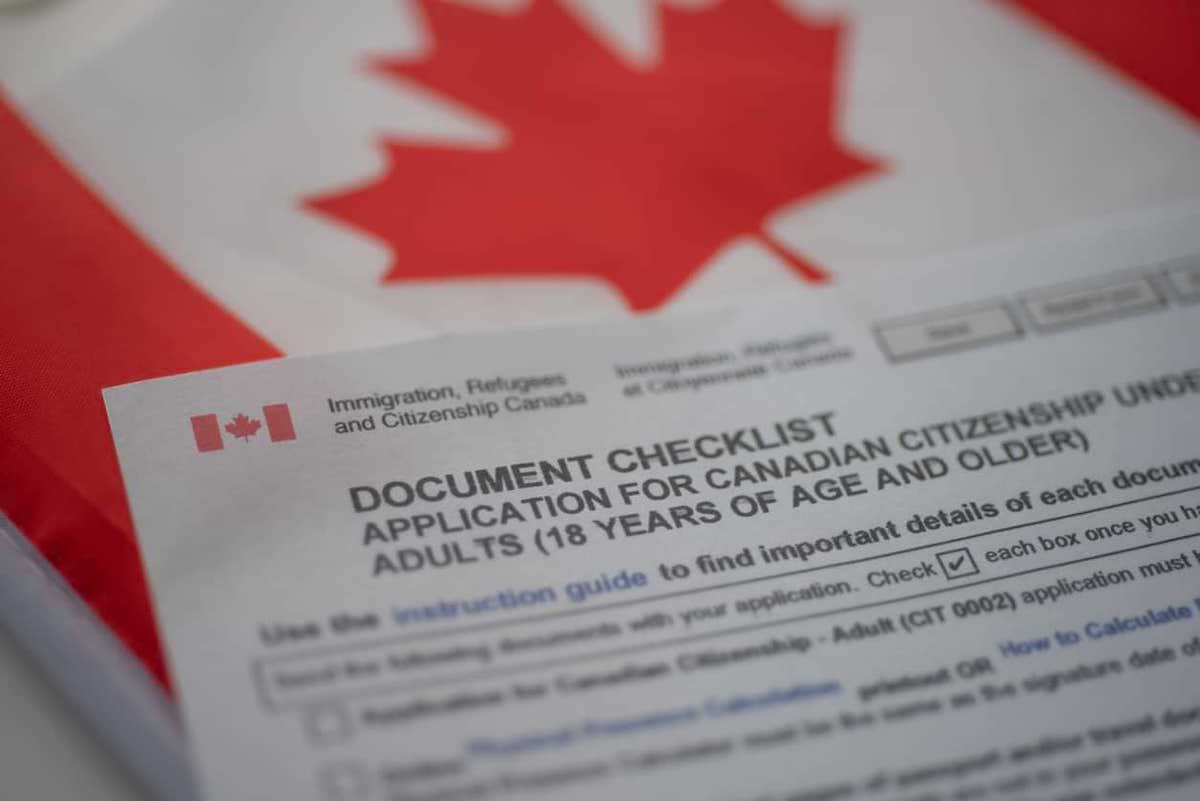
The changes, released Aug. 25, affect four documents: application form CIT 0001, checklist CIT 0014, physical presence form CIT 0555 and the instruction guide. The update explains how applicants can prove that a Canadian parent accumulated at least 1,095 days of physical presence in Canada before a child’s birth.
The physical presence rule applies to children born outside Canada on or after Dec. 15, 2025, when their Canadian parent was also born outside Canada. In those cases, the parent must have spent a cumulative 1,095 days in Canada before the child was born for citizenship to pass to the next generation.
People born before Dec. 15, 2025, are not subject to this test. Bill C-3 removed the first-generation limit for that group.
CIT 0001 now tells applicants to submit CIT 0555 when they answer “yes” to the physical presence question. The updated CIT 0555 says, “All information provided in this form is subject to verification by IRCC,” and asks for contact details for people or organizations able to confirm the declared periods in Canada.
IRCC says supporting records must be clear, readable colour copies of authentic documents. Accepted evidence includes employment or school records, travel records, housing records, Canadian government documents and affidavits from organizations or third parties familiar with the parent’s time in Canada.
Affidavits must be sworn before an authorized commissioner and include the affiant’s name, mailing address and email address or phone number. Applicants and family members cannot swear these affidavits.
IRCC removed earlier wording that said partial days count as full days and that the required days need not be consecutive. However, the calculation example on CIT 0555 still counts both arrival and departure dates as full days.
The form continues to ask applicants to add separate trips together, indicating that the 1,095 days remain cumulative rather than consecutive.
Applicants with files in process can send missing records through the IRCC web form using their Unique Client Identifier and application number. IRCC says applicants must report changes while an application is being processed.
Incomplete applications are returned rather than refused, allowing applicants to correct the problem and resubmit, though processing restarts. Officers may request additional documents at any stage.
Applicants should keep contact information current and explain in writing when requested records do not exist. Those relying on affidavits should ensure the person giving the statement can provide contact details and swear it properly.
IRCC can select applications for quality-assurance reviews involving interviews, original-document checks, more evidence and, in some cases, DNA testing to confirm parentage.
A child born in Canada remains a citizen at birth. The test also does not apply in certain Crown servant cases. Families who cannot meet the requirement may have other options, including permanent residence followed by a citizenship grant. Special citizenship routes may also exist in cases where a child would otherwise be stateless.









Having an ‘Identity Verified’ badge or being ‘Identity Verified’ simply indicates that an individual has submitted information to complete our identity verification process or we have conducted internal verification using various authorized websites. While this process includes safeguards, it does not guarantee that the person is who they claim to be.
If you encounter any issues with this profile, please report them here. While all consultants who are verified have RCIC ID, we may not have the latest data in terms of their renewal/cancellation/discontinuation of their RCIC ID.
╳The “Verified Consultants” profiles on Immiperts.com are independently compiled using publicly available information from multiple sources, including the official CICC Public Register, consultants’ own websites, other public directories, and social media.
Immiperts.com is a completely independent platform and is not affiliated with, endorsed by, or connected to the College of Immigration and Citizenship Consultants (CICC), IRCC, or any immigration consultant.
All information is collected manually and is for educational and informational purposes only. Consultants may claim, update, or request removal of their profile by contacting us at hello@immiperts.com.
Users are strongly advised to always verify the latest authorization status directly on the official CICC Public Register at college-ic.ca.