
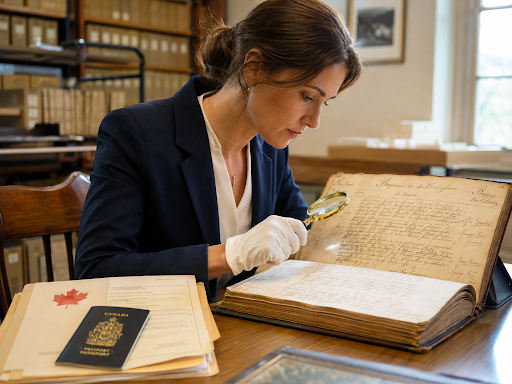


Historic Quebec parish records may help applicants trace family links needed for Canadian citizenship by descent.
Old Quebec baptism records can appear difficult to understand, especially when they are written in 19th-century French cursive. But applicants researching Canadian citizenship by descent may not need to speak French to identify the most important information.
Catholic parish records followed a largely consistent format because church and civil authorities required priests to record the same basic details in a regular order. Once researchers understand that structure, many baptismal entries become easier to read.
Parish registers often contain several types of records on the same page.
A letter in the margin usually identifies the type of entry. “B” stands for baptême, or baptism, while “S” means sépulture, or burial.
The name written beside the letter identifies the person involved. This helps researchers quickly determine whether they have found a relevant birth and baptism entry.
Most baptism records then follow a familiar sequence: the date, the child’s name, birth information, parents, godparents and signatures.
Dates were commonly written in words rather than numbers. Phrases such as née de ce jour, née hier or née aujourd'hui indicate that the child was born the same day, the previous day or that day.
One particularly useful feature is that Quebec priests generally recorded mothers under their maiden names. That can help researchers follow a maternal family line without immediately needing a separate marriage record.
The father’s occupation and parish may also appear. Common occupations found in historic records include farmer, day labourer, bailiff and merchant.
Researchers should not rely only on the child’s name when deciding whether they have found the correct person. Quebec families were often large, and relatives frequently shared names.
Matching both parents is more reliable. A father’s occupation, parish and the date of the baptism can provide additional confirmation.
Historic Quebec naming customs can create another challenge.
Until the late 1960s, Catholic children were often baptized with several given names. Girls commonly received Marie as a first name, while boys often received Joseph. Another name might honour a godparent, while a later name became the one used in everyday life.
As a result, the name in a baptism register may not exactly match the name appearing in later family documents.
Such differences can matter in citizenship applications because Immigration, Refugees and Citizenship Canada may review inconsistencies across documents.
Corrections, unnamed children, different handwriting and non-French family names can also appear in parish books. Some early Catholic records were written in Latin, while Protestant and Jewish communities followed different record-keeping practices.
A key rule also applies to Quebec documents used for immigration purposes. IRCC does not accept Quebec birth or marriage certificates issued before January 1, 1994. The issue date of the document matters, not the date when the birth or marriage took place.
Older records may be held by the Bibliothèque et Archives nationales du Québec, while more recent records fall under the Directeur de l'état civil.
For very old events, BAnQ may provide a certified copy of the original baptismal entry rather than a modern birth certificate.
Applicants can search historic Quebec parish records through resources including FamilySearch, GenealogyQuebec, the Drouin Collection and BAnQ’s digital archives.










Having an ‘Identity Verified’ badge or being ‘Identity Verified’ simply indicates that an individual has submitted information to complete our identity verification process or we have conducted internal verification using various authorized websites. While this process includes safeguards, it does not guarantee that the person is who they claim to be.
If you encounter any issues with this profile, please report them here. While all consultants who are verified have RCIC ID, we may not have the latest data in terms of their renewal/cancellation/discontinuation of their RCIC ID.
╳The “Verified Consultants” profiles on Immiperts.com are independently compiled using publicly available information from multiple sources, including the official CICC Public Register, consultants’ own websites, other public directories, and social media.
Immiperts.com is a completely independent platform and is not affiliated with, endorsed by, or connected to the College of Immigration and Citizenship Consultants (CICC), IRCC, or any immigration consultant.
All information is collected manually and is for educational and informational purposes only. Consultants may claim, update, or request removal of their profile by contacting us at hello@immiperts.com.
Users are strongly advised to always verify the latest authorization status directly on the official CICC Public Register at college-ic.ca.