
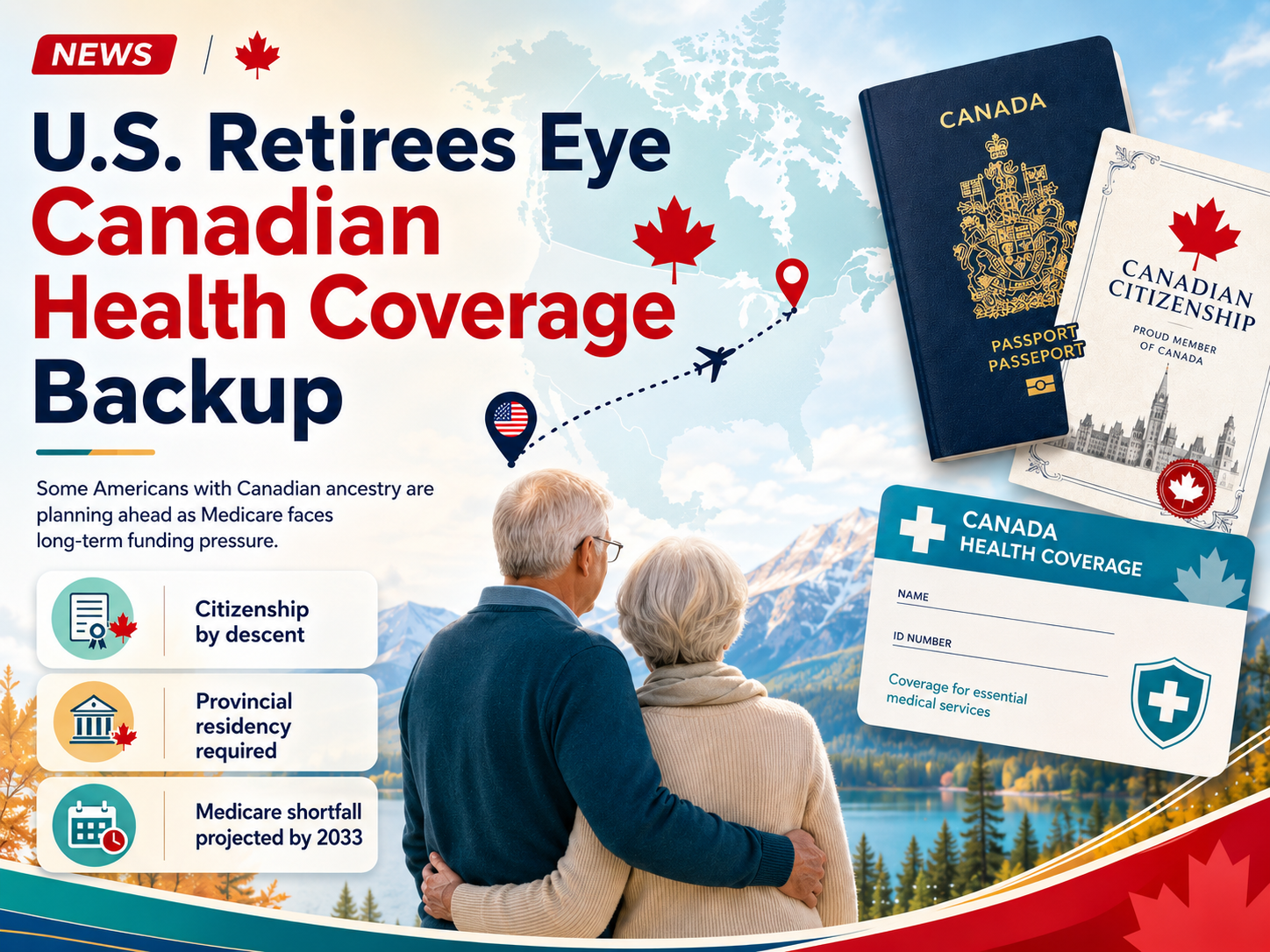


Some U.S. retirees with Canadian ancestry are planning ahead as Medicare faces long-term funding pressure.
As Medicare faces growing financial pressure in the United States, some American retirees are looking north for a possible backup plan: Canadian public health insurance.
The interest comes as millions of Americans may qualify for Canadian citizenship by descent following changes to Canada’s citizenship rules. Under the new law, Americans with Canadian ancestry may be eligible for citizenship if they were born before December 15, 2025.
For those who qualify, Canadian citizenship brings the same legal rights as citizens born in Canada, including the ability to settle in Canada and apply for publicly funded health coverage through a province or territory.
Americans who believe they qualify by descent must first apply for proof of Canadian citizenship.
Applicants need official documents showing a clear family line from a Canadian ancestor. This can include birth certificates, marriage certificates, and other records from both Canadian and U.S. authorities.
A typical application may involve proving descent through several generations, such as a Canadian-born great-grandparent, followed by documents connecting each generation down to the applicant.
The application is completed using Canada’s citizenship form CIT 0001, along with the required supporting documents and fee payment. It is then submitted by mail or courier to Canada’s citizenship department.
Applicants may complete the process themselves or use an authorized representative, such as a licensed Canadian immigration lawyer. If a representative is used, it must be declared properly. Errors or missing details can delay or even lead to refusal of the application.
Current processing can take about 12 months if the application is complete and moves smoothly. Urgent processing may be requested in certain cases, including a need for health care, although faster timelines are not guaranteed.
Canadian citizenship alone does not automatically provide instant public health insurance.
Citizens must meet the rules of the province or territory where they live. Each region runs its own health insurance plan, such as Ontario’s OHIP or British Columbia’s MSP.
Most plans require a person to establish residency. Some provinces or territories also have waiting periods before coverage begins. Others may provide coverage once residency is established.
In many provinces, residents can keep coverage year-round if they live in Canada for at least five or six months each year. This means some U.S.-Canadian dual citizens may be able to spend part of the year in the United States while keeping Canadian coverage.
Canadian public health insurance usually covers visits to family doctors, emergency rooms, hospital care, specialist appointments, medically necessary surgeries, and treatment for serious illnesses.
However, many services may not be covered. These can include prescription drugs, dental care, orthodontics, optometry, physiotherapy, counselling, chiropractic care, and elective cosmetic surgery.
Wait times can also be a major concern. Canadians may wait months for specialist appointments, imaging, or non-emergency surgeries, depending on the province, region, and medical urgency.
For many American retirees, Canadian citizenship is not about moving immediately. It is about having another option.
The 2025 report from the Trustees of the Social Security and Medicare trusts projects a Medicare trust shortfall by 2033. That uncertainty has pushed some eligible Americans to prepare early.A Canadian passport and proof of citizenship may not solve every health care concern, but for some retirees, they offer peace of mind and a practical backup in uncertain times.












Having an ‘Identity Verified’ badge or being ‘Identity Verified’ simply indicates that an individual has submitted information to complete our identity verification process or we have conducted internal verification using various authorized websites. While this process includes safeguards, it does not guarantee that the person is who they claim to be.
If you encounter any issues with this profile, please report them here. While all consultants who are verified have RCIC ID, we may not have the latest data in terms of their renewal/cancellation/discontinuation of their RCIC ID.
╳The “Verified Consultants” profiles on Immiperts.com are independently compiled using publicly available information from multiple sources, including the official CICC Public Register, consultants’ own websites, other public directories, and social media.
Immiperts.com is a completely independent platform and is not affiliated with, endorsed by, or connected to the College of Immigration and Citizenship Consultants (CICC), IRCC, or any immigration consultant.
All information is collected manually and is for educational and informational purposes only. Consultants may claim, update, or request removal of their profile by contacting us at hello@immiperts.com.
Users are strongly advised to always verify the latest authorization status directly on the official CICC Public Register at college-ic.ca.